
Have you ever walked into a room and forgotten why you went there, or paused mid-sentence because a familiar word suddenly disappeared? In casual English, someone might call that a brain fart.
The phrase is humorous and informal, but it can describe an experience many people recognize: a brief mental lapse, moment of forgetfulness, or simple mistake.
Still, the expression can be confusing. Is it an idiom? Is it the same as brain fog? What can you say instead at work? And does the phrase have anything to do with actual flatulence? This guide covers the phrase’s meaning, synonyms, origin, and uses.
It also answers related questions while separating a brief lapse in thought from digestive gas and persistent cognitive symptoms.
What Does “Brain Fart” Mean?
Brain fart is an informal, mildly vulgar expression for a brief mental lapse. It usually refers to forgetting something simple, losing a thought, mixing up a fact, or making an avoidable mistake for a moment.
Cambridge Dictionary defines it as a rude expression for a mistake or idea, or a moment of forgetting or confusion; Merriam-Webster describes it as a mental lapse often associated with carelessness, forgetfulness, or inattention.
For example, if Maya knows her colleague’s name but blanks on it during an introduction, she might say, “Sorry, I had a brain fart.”
The phrase is usually self-deprecating and humorous when someone applies it to their own small mistake. Directed at another person, however, it can sound dismissive.
It is a noun phrase, commonly used with have or had: “I had a brain fart.” The plural is brain farts. It is not a medical diagnosis or a clinical term.
Brain Fart Synonyms and Related Alternatives
There is no perfect substitute for every use. Choose a phrase based on whether you forgot something, lost focus, or made an error.
| Alternative | Best use | Example |
|---|---|---|
| Mental lapse | Neutral or professional wording | I had a brief mental lapse and entered the wrong date. |
| Momentary lapse | Formal description of a short error | It was a momentary lapse in concentration. |
| Memory slip | Temporarily forgetting a detail | It was a memory slip; I remembered later. |
| Mental blank | Suddenly being unable to think of what to say | I had a mental blank during the presentation. |
| Moment of forgetfulness | Plain, gentle everyday wording | It was a moment of forgetfulness. |
| Slip of the mind | Light, conversational wording | Her name escaped me—a slip of the mind. |
| Tip-of-the-tongue moment | Being unable to retrieve a known word or name | I had a tip-of-the-tongue moment with the actor’s name. |
| Lapse in concentration | Attention briefly wandered | I missed the instruction after a lapse in concentration. |
| Mistake | General description | I made a mistake in the spreadsheet. |
| Oversight | Something was unintentionally missed | Leaving out the attachment was an oversight. |
These are contextual alternatives, not exact synonyms. A tip-of-the-tongue moment concerns word retrieval; an oversight is something missed; and a mental lapse may describe either forgetfulness or an error.
How to Say “Brain Fart” Professionally
In professional or academic writing, choose a neutral expression that identifies what happened. For example:
- “I had a brief lapse in concentration and entered the wrong figure.”
- “That was a momentary oversight; I’ve corrected it.”
- “I experienced a temporary mental blank during the presentation.”
- “I momentarily forgot the client’s name.”
- “I made a minor error and have updated the file.”
A useful rule: use oversight when something was missed, memory slip when you forgot a detail, and lapse in concentration when your attention wandered. These expressions sound more composed and are more specific than casual slang.
Brain Fart vs. Brain Fog
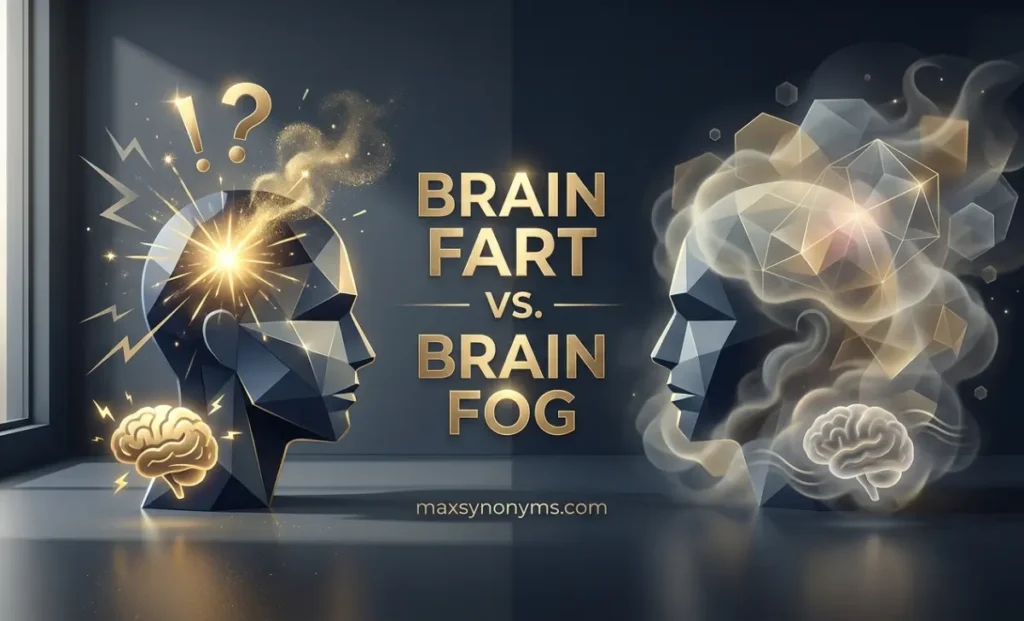
The expressions are related to thinking, but they describe different experiences. Neither is a formal diagnosis by itself.
| Expression | Usual meaning | Typical duration or pattern |
|---|---|---|
| Brain fart | A brief, isolated lapse, such as forgetting a name or making a small error | Usually momentary or occasional |
| Brain fog | A colloquial description of ongoing or recurring difficulty with focus, clarity, or memory | Can persist or recur over a longer period |
Someone might have a brief mental blank while tired and jokingly call it a brain fart. A person who repeatedly feels unfocused or mentally cloudy may describe that broader experience as brain fog.
These everyday expressions do not explain the cause. If cognitive changes persist, worsen, or interfere with daily life, consider discussing them with a qualified healthcare professional rather than assuming a cause.
Opposite of “Brain Fart”
There is no standard one-word antonym. Depending on the sentence, possible contrasts include mental clarity, clear thinking, focus, concentration, presence of mind, or accurate recall.
- “I had a mental blank” contrasts with “I had clear recall.”
- “I lost my train of thought” contrasts with “I stayed focused.”
- “I made a brief mental error” contrasts with “I responded with presence of mind.”
These are contextual opposites rather than dictionary antonyms. Choose the phrase that contrasts with the specific lapse.
Brain Fart in a Sentence: Real-Life Examples
- Forgetting a name: “I’m sorry—I had a brain fart and forgot your name for a second.”
- A small work mistake: “I had a brain fart while scheduling the meeting and chose Thursday instead of Tuesday.”
- Losing a thought: “I was explaining the recipe and forgot what ingredient came next.”
- A more formal version: “I made a momentary oversight in the first draft and have fixed it.”
The expression often works best when talking about your own harmless mistake. If someone else has made an error, describing the specific mistake is usually kinder and more useful.
What Does a Brain Fart Look Like?
It has no literal appearance. The phrase is figurative: it describes a momentary experience, such as pausing because you cannot recall a word, walking into a room and forgetting your purpose, or typing the wrong date despite knowing the correct one.
Online, a brain fart meme often uses a reaction image, a blank expression, or a caption about forgetting an obvious detail.
The humor comes from recognizing a small, relatable lapse—not from implying that someone has a medical condition.
In an article or workplace message, a plain description is usually clearer than the meme-style expression.
Origin of the Phrase
The phrase combines brain and fart as a humorous metaphor for a short-lived mental lapse. The Oxford English Dictionary identifies the earliest known evidence in the 1960s, with a recorded example from 1969 in the publication East Village Other.
That is the earliest evidence currently cited by the dictionary, not proof that one identifiable person coined the expression that year.
Because the phrase is casual and mildly vulgar, it appears most naturally in conversation, informal writing, and humor. For a formal report, use mental lapse, oversight, or momentary lapse in concentration instead.
Is “Brain Fart” an Idiom or Slang?
It is both an idiomatic expression and an informal, mildly vulgar phrase. Its meaning is figurative: the speaker is not describing gas coming from the brain.
In everyday conversation, people often use it humorously about themselves. In formal settings, it may sound too casual, so a neutral alternative is safer.
Brain Fart vs. Actual Flatulence
Despite the shared word, a brain fart and intestinal flatulence are unrelated meanings. One is an informal metaphor for a temporary mental lapse; the other is the release of gas from the digestive system. The questions below about farting refer to the literal digestive meaning.
Why do people say girls don’t fart?
That is a stereotype, not a biological fact. People of every gender pass gas. The idea persists largely because of embarrassment, social expectations, and jokes that portray bodily functions differently for women and men. In real life, digestive gas is a normal human process.
What is the smell of a fart called?
The ordinary term is odor or smell; there is no special everyday name for it. Intestinal gas is mostly made up of gases that have little or no smell.
Small amounts of sulfur-containing compounds, including hydrogen sulfide, can contribute a rotten-egg odor. Diet and gut bacteria can affect the smell.
What is a silent fart called?
Informally, people may say silent but deadly when a quiet fart has a strong odor. It is a joke, not a medical term. Quietness and smell are separate features; one does not reliably predict the other.
What if I pass gas 20 times a day?
Passing gas is normal, and frequency varies. Cleveland Clinic says people may pass gas as many as 25 times a day; Harvard Health notes that people pass gas at least 14 times daily on average.
So a count of 20 by itself does not establish a health problem. Pay attention to a sudden change or accompanying symptoms.
Seek medical advice if gas occurs with ongoing abdominal pain, significant bloating, diarrhea, constipation, or other concerning changes.
What is the deadliest fart in history?
There is no verified historical record of a “deadliest fart.” The phrase is usually a joke or an internet curiosity, not a documented medical or historical event. Ordinary flatulence is not a lethal weapon.
Separately, concentrated toxic gases can be dangerous in industrial or confined environments, but that is not the same thing as a person passing gas. Avoid presenting viral stories about a deadly fart as established fact.
A Prompt for Writing About “Brain Fart”
If you are using an AI writing tool or preparing a vocabulary exercise, this prompt can help keep examples natural and respectful:
Explain “brain fart” in simple English. Give realistic, harmless examples; distinguish it from brain fog and a tip-of-the-tongue moment; suggest professional alternatives; and avoid using it to insult or diagnose anyone. Cite factual claims.
Frequently Asked Questions
What does “brain fart” mean in slang?
It means a brief mental lapse, such as forgetting a word. It is informal and mildly vulgar.
What is another word for a brain fart?
Try mental lapse, memory slip, mental blank, or oversight, depending on what happened.
What is the opposite of a brain fart?
There is no exact antonym; mental clarity, focus, or presence of mind can contrast with it.
Where did the expression come from?
The exact coinage is unknown; OED records an example from 1969 in East Village Other.
Is brain fart an idiom?
Yes. It is an informal idiom for a short mental lapse, not literal gas from the brain.
How can I say it professionally?
Use momentary lapse, oversight, or lapse in concentration, as appropriate.
Is a brain fart the same as brain fog?
No. It usually means one brief lapse; brain fog describes broader or recurring reduced clarity or focus.
Why do people say women do not fart?
It is a stereotype. People of every gender pass gas; embarrassment and social expectations sustain the myth.
Conclusion
A brain fart is an informal, mildly vulgar idiom for a brief mental lapse: forgetting a name, losing a thought, or making a small mistake.
Depending on the situation, mental lapse, memory slip, mental blank, oversight, or lapse in concentration may be clearer.
There is no exact opposite, but mental clarity, focus, and presence of mind work as contextual contrasts.
The phrase also differs from brain fog, a colloquial term for broader or recurring reduced clarity.
Read More Blogs:
- Movement Synonyms: Words for Motion, Change, and Progress
- Thank You for the Explanation: Meaning, Usage, and Polite Alternatives
- Old Synonyms: 50 Words for People, Things, Traditions, and More

I am Ali Hamza, a writer and language lover with four years of experience creating content about synonyms, vocabulary and English word usage. I like making words and meanings easier to understand through clear explanations and real-life examples.
As the author of maxsynonyms.com I focus on helping readers find synonyms improve their vocabulary and pick the right words for different situations. My goal is to provide easy-to-read content that helps students, writers, professionals and English learners.
Through maxsynonyms.com I am dedicated to sharing quality language tools that make learning English simple, interesting and available, to all.