Have you ever written happy several times and felt that it wasn’t quite the word you wanted? Maybe you’re describing someone who has just received wonderful news, or someone who feels peaceful and satisfied with everyday life.
Both people may be happy, but their feelings aren’t exactly the same.
Choosing a more specific word can make your writing clearer and more natural. Glad often describes a positive reaction, content suggests calm satisfaction, and thrilled conveys excitement.
However, these alternatives don’t all mean the same thing, so replacing happy without considering the context can change your meaning.
This guide explains the most useful alternatives, shows how they differ, and gives examples of common phrases such as happy with, happy about, and happy for. You’ll also find antonyms, grammar tips, and simple advice for choosing a word that fits.
What Does “Happy” Mean?
Happy is an adjective that describes a feeling of pleasure, joy, or satisfaction. It can refer to a passing emotion, a reaction to an event, or a person’s general sense of well-being.
For example:
- I’m happy to see you.
- She’s happy with her new job.
- They had a happy childhood.
The word is common in everyday English because it works in many situations. At the same time, that broad meaning can make it less precise than a more specific alternative.
Pronunciation: happy is pronounced /ˈhæp.i/, with the stress on the first syllable.
Common Synonyms for Happy
No single synonym fits every sentence. Some words describe a reaction, others a settled mood, and a few suggest very strong excitement.
| Word | Meaning | Best use | Example |
|---|---|---|---|
| Glad | Pleased or relieved about something | A reaction to an event | I’m glad you called before leaving. |
| Pleased | Satisfied or approving | A result, decision, or service | The client was pleased with the final draft. |
| Content | Calmly satisfied | A peaceful state of mind | He felt content after a quiet afternoon at home. |
| Cheerful | Positive and visibly good-humored | A person’s mood or manner | Her cheerful hello made us smile. |
| Upbeat | Positive and hopeful | Someone’s attitude or tone | The team remained upbeat during the project. |
| Joyful | Full of joy | A warm or meaningful occasion | It was a joyful family celebration. |
| Delighted | Very pleased | Good news or a pleasant surprise | We were delighted to hear that you could come. |
| Thrilled | Very excited and pleased | An exciting opportunity or event | I’m thrilled about the new position. |
| Elated | Extremely happy, often after success | A major achievement | She felt elated after passing her exams. |
| Ecstatic | Overwhelmingly happy and excited | An exceptional moment | The fans were ecstatic when their team won. |
| Overjoyed | Filled with great happiness | Emotional news or a reunion | They were overjoyed to welcome their new baby. |
| Blissful | Deeply peaceful and happy | A serene experience or state | They spent a blissful week by the lake. |
Everyday Reactions: Glad and Pleased
Glad is a natural choice when something has gone well or when you feel relief. Pleased usually points to satisfaction or approval.
- I’m glad the rain stopped before the game.
- We’re pleased with how the repairs turned out.
Use pleased when you want a slightly more formal tone. In casual conversation, glad often sounds more relaxed.
Calm Satisfaction: Content
Content doesn’t usually mean excited. It describes someone who feels satisfied with what they have or with how things are going.
- After dinner, she felt content and ready to read.
- He’s content with his life in a small town.
If a person has just won a competition, thrilled or elated may fit better than content. If they’re enjoying a quiet, comfortable moment, content may be just right.
A Positive Mood: Cheerful and Upbeat
Cheerful often describes a person’s manner, expression, or mood. Upbeat focuses more on a positive outlook, especially when a situation is challenging.
- Our cheerful neighbor waves to everyone on the street.
- Although the deadline was close, the staff stayed upbeat.
Strong Happiness: Delighted, Thrilled, and Ecstatic
These words express stronger feelings, but they differ in intensity. Delighted is enthusiastic and flexible. Thrilled emphasizes excitement. Ecstatic and overjoyed are much more intense.
- I was delighted by the thoughtful note.
- She was thrilled to meet her favorite musician.
- He was overjoyed when his family arrived.
- The children were ecstatic about the surprise trip.
Happy Synonyms by Context
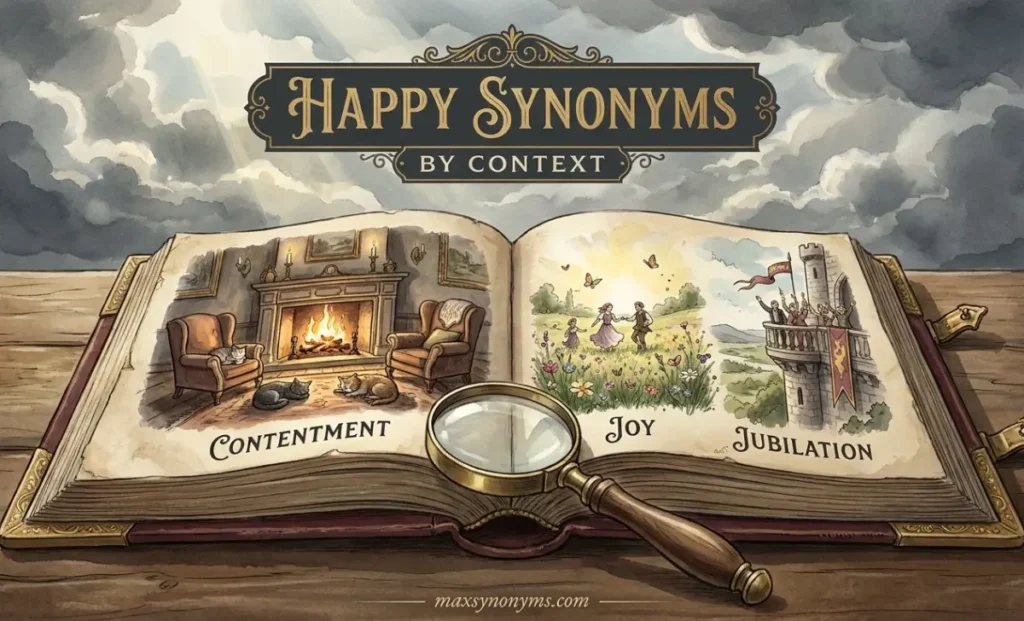
The best alternative depends on what is happening and how strong the feeling is.
| Situation | Words that may fit | Why |
|---|---|---|
| A casual reaction | Glad, happy | Familiar and natural in conversation |
| A good result | Pleased, satisfied | Focuses on approval or outcome |
| A relaxed moment | Content, blissful | Suggests calm or peaceful happiness |
| Someone’s manner | Cheerful, upbeat | Describes outward mood or attitude |
| A celebration | Joyful, delighted | Adds warmth and enthusiasm |
| Exciting news | Thrilled, overjoyed | Shows a strong positive reaction |
| A major success | Elated, ecstatic | Conveys intense happiness |
Happy vs. Glad vs. Pleased vs. Content
These words overlap, but each highlights a different part of the feeling.
| Word | Main idea | Example |
|---|---|---|
| Happy | A broad positive feeling | I’m happy with my new home. |
| Glad | A positive reaction, often with relief | I’m glad you got home safely. |
| Pleased | Satisfaction or approval | The teacher was pleased with our work. |
| Content | Calm satisfaction with a situation | She felt content with a simple plan. |
A useful rule is to use glad for a reaction, pleased for approval, and content for calm satisfaction. Choose happy when you want a broad, everyday word.
Common Phrases with “Happy”
The words that follow happy help explain what kind of happiness you mean.
Happy with
Use happy with to describe satisfaction with a person, thing, result, or situation.
- I’m happy with the new schedule.
- They’re happy with their choice of school.
Happy about
Use happy about when you’re pleased about an event, idea, or piece of news.
- She’s happy about the upcoming trip.
- We’re happy about the changes to the plan.
Happy for
Use happy for to show that you share someone else’s good feelings or success.
- I’m so happy for you and your family.
- They were happy for their friend when she got the job.
Happy to
Use happy to before a verb when you’re pleased or willing to do something.
- I’d be happy to help you carry those boxes.
- She was happy to answer the questions.
The meaning can depend on the sentence. I’m happy to help often means “I’m willing and pleased to help,” while I’m happy about helping puts more emphasis on the feeling.
Antonyms of Happy
The most suitable opposite depends on the sentence. Sad is a broad emotional opposite, while dissatisfied specifically describes not being pleased with a situation or result.
| Word | Meaning | Example |
|---|---|---|
| Sad | Feeling sorrow or unhappiness | He felt sad when the visit ended. |
| Unhappy | Not happy or satisfied | They were unhappy with the long delay. |
| Miserable | Extremely unhappy or uncomfortable | I felt miserable with a bad cold. |
| Gloomy | Low in mood or hope | The gloomy weather matched his mood. |
| Dissatisfied | Not pleased with something | She was dissatisfied with the service. |
Example Sentences
These examples show how different words can fit different situations:
- I’m glad you told me before the meeting.
- The students were cheerful as they walked into class.
- We were delighted by the warm welcome.
- He felt content after spending the afternoon in the garden.
- Despite the setback, the team stayed upbeat.
- She was thrilled when her story was published.
- They felt elated after finishing the race.
- The family was overjoyed to see their relatives again.
- I’m pleased with the way the presentation turned out.
- The children were ecstatic when they saw the puppy.
Common Mistakes to Avoid
| Less suitable wording | Better choice | Reason |
|---|---|---|
| I’m ecstatic that the package arrived on time. | I’m glad the package arrived on time. | Ecstatic may sound too intense for an ordinary event. |
| She felt content when she won the competition. | She felt thrilled when she won the competition. | Content suggests calm satisfaction, not excitement. |
| He was cheerful with the result. | He was pleased with the result. | Pleased with is the more natural phrase for satisfaction with an outcome. |
| I’m happy to you. | I’m happy for you. | Use happy for someone to share in their good news. |
| Replacing every use of happy with a different word | Keep happy when it’s the clearest choice | Variety should not make the writing less natural. |
How to Choose the Right Word
Before replacing happy, consider these three points:
- How intense is the feeling? Use pleased for measured satisfaction and ecstatic for overwhelming excitement.
- What caused it? Choose glad for a reaction, pleased for approval, and content for a settled feeling.
- What tone do you want? Glad sounds conversational; elated may feel more formal or expressive.
Then read the sentence aloud. If the alternative sounds exaggerated or changes the meaning, keep happy. A precise word is helpful, but a simple, natural word is better than a fancy one that doesn’t fit.
FAQs
What is the best synonym for happy?
There isn’t one best synonym for every sentence. Glad, pleased, cheerful, and delighted are useful choices, depending on whether you mean a reaction, approval, a positive mood, or strong pleasure.
What is a stronger word for happy?
Thrilled, elated, overjoyed, and ecstatic are stronger alternatives. Ecstatic usually expresses the most intense excitement.
Is “glad” the same as “happy”?
They’re similar, but not always interchangeable. Glad often describes a reaction to something, such as I’m glad you called. Happy can describe a broader mood or state.
What is the difference between “happy” and “content”?
Happy can describe many kinds of positive feelings, including excitement. Content usually means calmly satisfied with the way things are.
Is “pleased” a synonym for happy?
Yes, in some contexts. Pleased means satisfied or approving, so it works well when talking about a result, decision, or service.
What is the opposite of happy?
Sad is a common opposite. Depending on the context, unhappy, miserable, or dissatisfied may be more precise.
How do you use “happy for” in a sentence?
Use happy for when you feel pleased about someone else’s good news or success. For example: I’m happy for you—you worked hard for this.
How can I avoid repeating “happy” in my writing?
Think about the exact feeling first. Use cheerful for someone’s manner, content for calm satisfaction, or thrilled for excitement. Still, repeating happy is fine when it’s the clearest word.
Conclusion
There are many useful alternatives to happy, but the right one depends on the feeling and the situation.
Glad works well for everyday reactions, pleased highlights approval, and content describes calm satisfaction. To describe someone’s manner, choose cheerful or upbeat.
When a person feels stronger excitement, delighted, thrilled, elated, or ecstatic may fit.
These words are related, but they aren’t identical. A quiet evening may leave someone content, while a long-awaited opportunity may make them thrilled.
Before choosing a synonym, think about the cause and intensity of the feeling, then pick the word that sounds natural in your sentence.
There’s no need to avoid happy altogether: it remains a clear, useful word. The best writing uses variety when it adds meaning—not simply for the sake of variety.
Read More Blogs:
- Positive Synonyms: Better Words for a Positive Attitude and More
- Powerful Synonyms: Better Words for Strength, Influence, and Impact
- I Hope You Are Okay: Meaning, Alternatives, and Natural Replies
- Synonyms for Funny: Better Words for Every Situation

I am Ali Hamza, a writer and language lover with four years of experience creating content about synonyms, vocabulary and English word usage. I like making words and meanings easier to understand through clear explanations and real-life examples.
As the author of maxsynonyms.com I focus on helping readers find synonyms improve their vocabulary and pick the right words for different situations. My goal is to provide easy-to-read content that helps students, writers, professionals and English learners.
Through maxsynonyms.com I am dedicated to sharing quality language tools that make learning English simple, interesting and available, to all.