Have you ever written a sentence like “The photo conveys happiness” and wondered whether shows, expresses, or communicates would sound better? The right choice depends on what you mean.
Convey can describe sharing an idea or feeling, but it can also mean carrying or transporting something. That’s why its alternatives are not always interchangeable. For example, you can express an opinion, relay a message, or transport furniture—but swapping those verbs carelessly can make a sentence sound unnatural.
This guide explains the most useful synonyms for convey, groups them by meaning, and shows how they work in everyday, academic, and business writing. You’ll also find examples, grammar tips, common mistakes, and quick comparisons to help you choose a word that fits your sentence.
Meaning of “Convey”
Convey is a verb. It most often means to communicate or make an idea, feeling, or piece of information known. It can also mean to carry or transport someone or something from one place to another.
In simple terms, to convey something is to get it across—either as a message or by physically moving it. The word is pronounced kuhn-VAY.
- Communicate: “Her expression conveyed concern.”
- Transport: “The truck conveyed the supplies to the village.”
The sentence’s context tells you which meaning applies. A speech might convey a message; a vehicle might convey passengers.
Top Synonyms for “Convey”
There is no single perfect substitute for convey in every sentence. Choose an alternative based on whether you mean communicating something or moving it.
Synonyms for Communicating an Idea or Feeling
These words describe sharing meaning, thoughts, emotions, or information.
| Word | Meaning | Best use | Example |
|---|---|---|---|
| Communicate | Share information, thoughts, or feelings | General communication | “The manager communicated the schedule change.” |
| Express | Show or put a thought or feeling into words or actions | Opinions and emotions | “Maya expressed her thanks in a short note.” |
| Impart | Give information or knowledge to someone | Teaching or formal writing | “The guide imparted useful safety advice.” |
| Articulate | Express an idea clearly in words | Precise speech or writing | “He articulated his concerns at the meeting.” |
| Indicate | Point to or suggest something | Signs, evidence, or clues | “The dark clouds indicated that rain was near.” |
| Signify | Mean or represent something | Symbols and formal explanations | “A red light signifies that drivers must stop.” |
| Show | Make a feeling or quality visible | Everyday language | “Her smile showed how pleased she was.” |
| Explain | Make something easier to understand | Clarifying information | “The teacher explained the new assignment.” |
Synonyms for Passing Along a Message
Use these when information moves from one person or place to another.
| Word | Meaning | Best use | Example |
|---|---|---|---|
| Relay | Pass information from one person to another | Updates and messages | “Could you relay the news to the evening team?” |
| Transmit | Send information, signals, or data | Technology and formal contexts | “The device transmits data to the server.” |
| Pass on | Give information to someone else | Everyday conversation | “I’ll pass on your suggestion to Lena.” |
| Share | Give or discuss information with others | Friendly or collaborative settings | “He shared the results with his colleagues.” |
| Report | Give an account of information or events | News, work, and research | “The technician reported a problem with the equipment.” |
| Notify | Tell someone officially or directly | Notices and formal updates | “Please notify customers about the delay.” |
Synonyms for Carrying or Transporting
When convey means physically moving something, these alternatives may fit. They are not suitable substitutes when the sentence is about feelings or ideas.
| Word | Meaning | Best use | Example |
|---|---|---|---|
| Carry | Take something from one place to another | People or objects | “We carried the boxes upstairs.” |
| Transport | Move people or goods between places | Travel and logistics | “The service transports passengers to the airport.” |
| Deliver | Take something to its intended recipient or destination | Packages, supplies, and services | “The store delivered the groceries that afternoon.” |
| Transfer | Move something from one person, place, or system to another | Funds, data, or ownership | “They transferred the files to a shared folder.” |
| Move | Change the position or location of something | General, conversational use | “Can you move the chairs into the hall?” |
Which Words Describe the Way a Message Is Conveyed?
Sometimes you need a word for how a message comes across, rather than another verb for convey. These terms describe a message’s quality or delivery.
| Word or phrase | Meaning | Example |
|---|---|---|
| Clearly | In an easy-to-understand way | “The instructions clearly explain what to do.” |
| Directly | Without hiding or softening the point | “She directly stated what the team needed.” |
| Subtly | In a quiet or indirect way | “The film subtly suggests that the character feels lonely.” |
| Effectively | In a way that achieves the intended result | “The poster effectively communicates the safety message.” |
| Through body language | By facial expressions, posture, or gestures | “He showed his discomfort through body language.” |
These are not synonyms for convey itself. They can, however, help you describe the manner or channel of communication.
Antonyms of “Convey”
There is no one antonym that works for every meaning of convey. The opposite depends on what is being conveyed.
| Word or phrase | Opposite of which sense? | Example |
|---|---|---|
| Withhold | Keep information from someone | “They withheld the details until the review was complete.” |
| Conceal | Hide a fact, feeling, or intention | “He tried to conceal his disappointment.” |
| Misrepresent | Communicate something inaccurately | “The headline misrepresented what the report said.” |
| Keep | Not give or pass something on | “She kept the message to herself.” |
| Retain | Hold on to something instead of transferring it | “The company retained ownership of the equipment.” |
These are contextual opposites, not universal antonyms. For example, withhold can oppose convey information, but it does not mean “move in the opposite direction” of transport.
Example Sentences
The examples below show how convey and its alternatives change with context.
Everyday Conversation
- “I couldn’t convey how grateful I was, so I wrote her a thank-you card.”
- “His raised eyebrows showed that he was surprised.”
- “Please pass on the invitation to your sister.”
- “The driver carried the bags to the front door.”
Business and Professional Writing
- “The director communicated the new deadline to the staff.”
- “Please relay the client’s feedback to the design team.”
- “The report indicates that costs have increased.”
- “The courier delivered the signed contract before noon.”
Academic and Formal Writing
- “The study communicates its findings through charts and written analysis.”
- “The author articulates a clear argument about public access.”
- “These results suggest a link between sleep and concentration.”
- “The introduction explains the purpose of the research.”
Creative Writing
- “A single glance conveyed the character’s fear.”
- “The empty kitchen suggested that the family had left in a hurry.”
- “The poem expresses grief without naming it directly.”
“Convey” vs. Similar Words
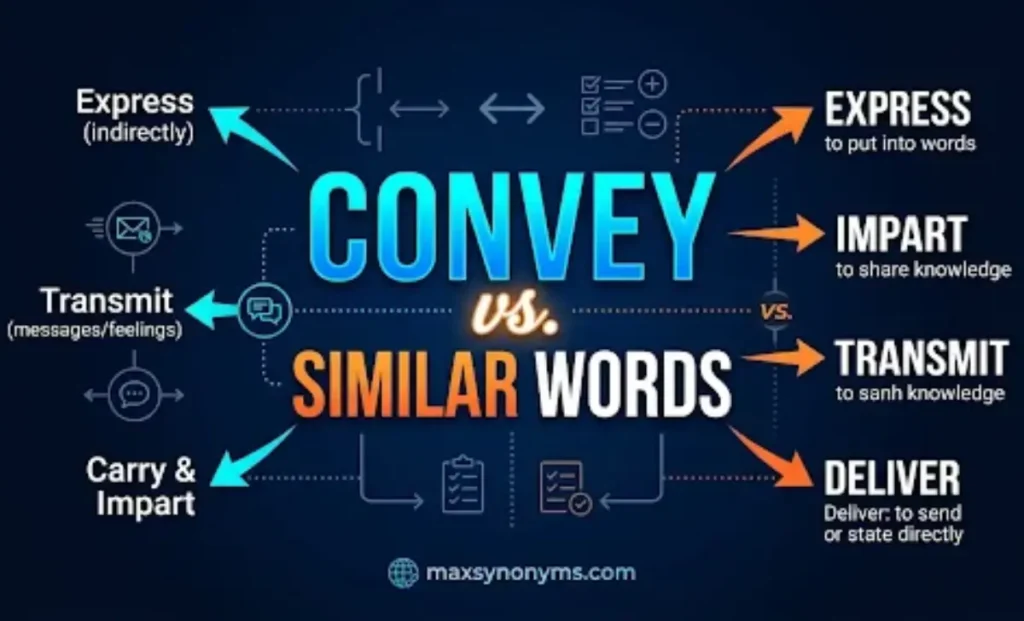
Several alternatives have related meanings, but their nuances differ.
| Word | Meaning | Main difference | Best use |
|---|---|---|---|
| Convey | Communicate or transport | Broad; the context determines the sense | Ideas, impressions, messages, or movement |
| Communicate | Share information or feelings | Focuses on an exchange or act of communication | People, teams, and organizations |
| Express | Make a thought or feeling known | Often focuses on the speaker’s own emotion or opinion | Feelings, views, and thanks |
| Impart | Give information or knowledge | Has a more formal or teaching-related feel | Advice, knowledge, and wisdom |
| Relay | Pass information along | Highlights that a message is being forwarded | Updates, instructions, and news |
| Transport | Move people or goods | Physical movement, not communication | Passengers, cargo, and supplies |
Convey vs. Communicate
Communicate usually refers to sharing information, thoughts, or feelings. Convey can do that too, but it can also describe the impression created by a look, image, or piece of writing.
- “We communicated the change to the staff.” The staff received the information.
- “The photograph conveys calm.” The photograph creates or expresses an impression.
Quick rule: Choose communicate for the act of sharing information; choose convey when you mean the message, feeling, or impression that comes across.
Convey vs. Express
Express often emphasizes the person showing their own feeling or view. Convey can focus more on what an audience understands or senses.
- “She expressed her frustration.”
- “Her tone conveyed frustration.”
Quick rule: Use express for putting a feeling or opinion forward; use convey for the meaning or impression that reaches someone.
Convey vs. Impart
Impart means to give knowledge, information, or a quality. It often sounds more formal than convey.
- “The mentor imparted practical advice.”
- “The mentor conveyed the importance of patience.”
Quick rule: Use impart when someone gives knowledge or advice; use convey for communicating a broader message, feeling, or impression.
Convey vs. Relay
Relay is a good choice when you pass a message along, often from someone else. Convey is broader and does not necessarily mean the message came from another person.
- “I relayed the manager’s instructions to the team.”
- “The manager conveyed a sense of urgency.”
Quick rule: Use relay when passing information on; use convey for communicating meaning more generally.
Best Alternatives for Different Situations
| Situation | Useful alternatives | Why |
|---|---|---|
| Sharing an opinion | Express, state, articulate | These make a viewpoint clear |
| Giving information | Communicate, inform, notify | Each focuses on sharing or announcing information |
| Passing along a message | Relay, pass on, report | These suggest forwarding or recounting details |
| Writing about evidence | Indicate, suggest, show | These describe what facts or signs point to |
| Describing emotion in art | Express, suggest, evoke | These can describe the feeling an audience perceives |
| Moving goods | Transport, carry, deliver | These refer to physical movement |
| Formal or academic writing | Communicate, impart, indicate | These often suit explanatory contexts |
Grammar Tips
Convey is a transitive verb: it normally takes an object—the thing being communicated or moved.
- “The letter conveyed the news.”
- “The van conveyed the equipment.”
Common patterns include:
- Convey something: “Her expression conveyed concern.”
- Convey something to someone: “He conveyed the decision to the committee.”
- Convey that + clause: “The message conveyed that the event was postponed.”
- Convey an impression of something: “The opening scene conveys an impression of isolation.”
The standard verb forms are convey, conveys, conveyed, and conveying. The noun conveyance can refer to the act or means of transporting something, especially in formal contexts. It is not usually the everyday noun for a communicated message.
Common Mistakes
| Incorrect or awkward | Better choice | Reason |
|---|---|---|
| “She conveyed me the instructions.” | “She conveyed the instructions to me.” | Use convey something to someone. |
| “The bus communicated passengers downtown.” | “The bus transported passengers downtown.” | Communicate refers to sharing information, not carrying people. |
| “He conveyed his angry.” | “He conveyed his anger.” | Use the noun anger after his, or write “He seemed angry.” |
| “The sign transported that the road was closed.” | “The sign indicated that the road was closed.” | A sign communicates information; it does not physically transport it. |
| “The poem relayed sadness.” | “The poem conveyed sadness.” | Relay usually means passing a message along; convey is more natural for an emotional impression. |
Pro Writing Tips
Before replacing convey, identify what the sentence needs to say. Is someone sharing a message, showing a feeling, suggesting an idea, or moving an object? That answer will narrow your choices.
Then consider the audience and tone. Show and pass on feel conversational; impart and articulate are more formal. In professional writing, communicate is often clear and neutral. In creative writing, suggest or evoke may better describe an impression or emotional response.
Most importantly, choose accuracy over variety. Replacing a repeated word can improve a draft, but a fancy alternative that changes the meaning will make it worse. The clearest word is usually the strongest.
Related Words
These terms often appear alongside convey because they relate to communication or movement:
- Communication: message, information, idea, opinion, meaning, signal
- Feelings and impressions: emotion, tone, expression, gesture, body language
- People in an exchange: speaker, writer, sender, audience, reader, recipient
- Communication methods: conversation, email, report, speech, image
- Physical movement: transport, delivery, cargo, passenger, transfer
These related words can help you choose a more precise verb. For instance, a sender may relay information to a recipient, while a vehicle may transport cargo.
FAQs
What is the best synonym for “convey”?
It depends on the sentence. Communicate works for sharing information, express suits feelings or opinions, relay means passing a message on, and transport means moving something physically.
What is another word for “convey a message”?
You can say communicate a message, relay a message, or pass on a message. Use relay when someone is forwarding information from another person or source.
Is “convey” the same as “communicate”?
Not exactly. Both can mean sharing information, but convey also means carrying or transporting something. It can also describe an impression created by a sound, image, or expression.
What is a formal synonym for “convey”?
Impart, articulate, and communicate may work in formal writing, depending on the sentence. Impart often refers to knowledge or advice; articulate emphasizes clear expression.
What is the opposite of “convey”?
There is no single opposite for every meaning. Withhold can oppose conveying information, while conceal can oppose making a feeling or fact known.
Can “convey” mean “transport”?
Yes. In formal or specific contexts, convey can mean to carry or transport people or things. In everyday writing, carry, move, deliver, or transport may sound more natural.
How do you use “convey” in a sentence?
Use it with the thing being communicated or moved: “The email conveyed the new policy,” or “The vehicle conveyed supplies to the site.” You can also say, “The painting conveys a feeling of peace.”
What is the difference between “convey” and “express”?
Express often focuses on someone showing their own thought or feeling. Convey can focus on the message or impression that another person understands. For example, “She expressed concern” and “Her voice conveyed concern” are both natural, but they emphasize different things.
Conclusion
The best synonym for convey depends on the job the word is doing. When you share information, consider communicate, relay, or pass on. For a feeling or opinion, express and articulate may be more precise.
If a sign, image, or piece of evidence points to something, try indicate, show, or suggest. For physical movement, choose carry, transport, or deliver instead.
These words overlap, but they are not interchangeable in every sentence. A bus can transport passengers, while a facial expression can convey worry. When editing, first decide whether your sentence is about a message, an emotion, an impression, or movement.
Then choose the clearest word for that meaning. That simple check will help you use synonyms for convey naturally and accurately.

I am Ali Hamza, a writer and language lover with four years of experience creating content about synonyms, vocabulary and English word usage. I like making words and meanings easier to understand through clear explanations and real-life examples.
As the author of maxsynonyms.com I focus on helping readers find synonyms improve their vocabulary and pick the right words for different situations. My goal is to provide easy-to-read content that helps students, writers, professionals and English learners.
Through maxsynonyms.com I am dedicated to sharing quality language tools that make learning English simple, interesting and available, to all.