Have you used big for a house, a crowd, and an important choice? The word works in all three cases. However, it means something different each time. A big house is large. A big crowd has many people. A big choice matters.
A more exact word can make your meaning clearer. For example, huge describes size. Numerous means many. In contrast, major usually means important. These words are related, but they do not always fit the same sentence.
This guide explains useful alternatives to big. It also compares common synonyms and gives simple examples. You’ll find antonyms, grammar tips, and common mistakes. As a result, you can choose a word that fits what you mean.
What Does “Big” Mean?
Before choosing a synonym, think about what big describes. It can mean large in size, amount, or number. It can also mean important.
For example:
- They bought a big table. — large in size
- We invited a big group. — many people
- It was a big decision. — important
Big is an adjective. Its comparative form is bigger, and its superlative form is biggest. The word is common in everyday English. Still, a more exact choice may help your reader understand you.
Common Synonyms for Big
No single word can replace big in every sentence. Instead, choose a word that matches your meaning.
| Word | Simple meaning | Best use | Example |
|---|---|---|---|
| Large | Big in size or amount | General use | They moved into a large apartment. |
| Huge | Very large | Strong emphasis on size | A huge wave reached the shore. |
| Enormous | Extremely large | Objects, places, or amounts | An enormous tree stood by the road. |
| Gigantic | Extremely large | Informal descriptions | The children built a gigantic sandcastle. |
| Massive | Very large or heavy | Objects, damage, or change | The storm caused massive damage. |
| Vast | Covering a wide area | Land or open space | They crossed a vast field. |
| Immense | Very large in size or amount | Strong descriptions | The job took immense effort. |
| Substantial | Large enough to matter | Costs or amounts | The repair came with a substantial cost. |
| Considerable | Fairly large in amount | Time or effort | The work took considerable time. |
| Major | Important or serious | Events or choices | The school announced a major change. |
| Significant | Important or large enough to matter | Results or changes | The team made significant progress. |
| Numerous | Many separate people or things | Countable items | The report lists numerous examples. |
Words for Physical Size
When you mean that something is large, large is a clear choice. For more emphasis, use huge, enormous, or gigantic. Also, massive can suggest great weight.
- The hotel has a large pool.
- A huge truck blocked the road.
- We saw an enormous whale from the boat.
- A massive stone wall stood around the town.
For a wide area, vast often sounds more natural than big. For example, you can describe a vast forest or a vast stretch of land.
Words for Amounts and Numbers
If big describes an amount, choose a word that fits. Substantial and considerable often describe money, time, or effort. By comparison, numerous means many separate things.
- The project needs a substantial budget.
- We spent considerable time getting ready.
- Numerous visitors came to the museum.
You can also use abundant when something is available in large amounts. For example, The area has abundant trees. However, you would not normally call one large tree “abundant.”
Words for Importance
Sometimes big means that something matters. In this case, major, significant, or important may be clearer than huge.
- It was a major choice for the family.
- The change had a significant effect.
- This is an important moment in the story.
A big building is large in size. In contrast, a major building project may be important or cover a wide area. The rest of the sentence helps show the meaning.
Big Synonyms by Context
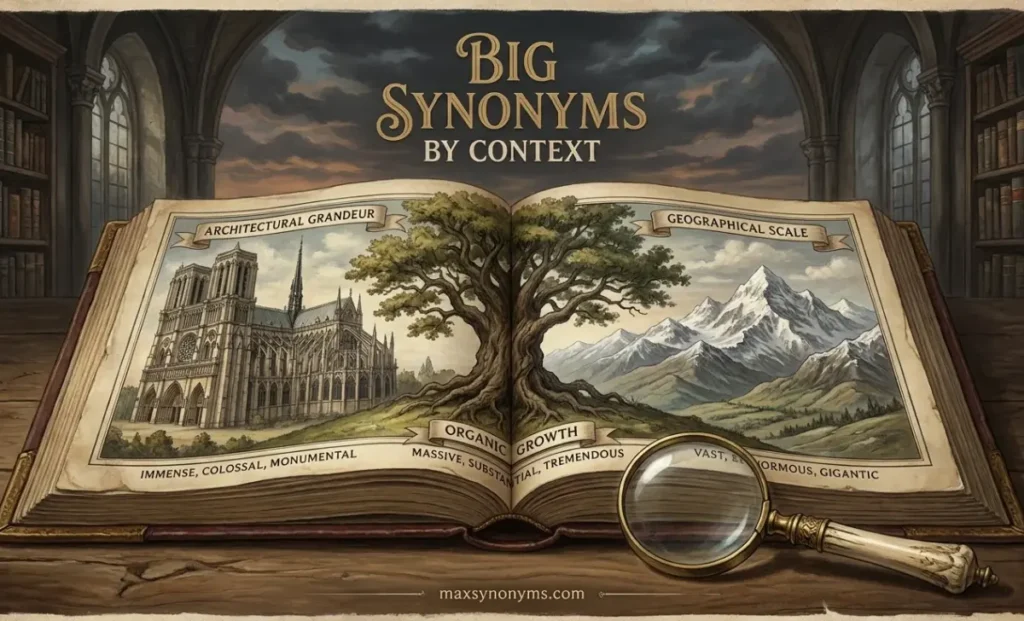
The best word often depends on the noun it describes. Use this table to find an alternative for common situations.
| Context | Words that may fit | Example |
|---|---|---|
| A big house | Large, spacious, huge | They moved into a spacious home. |
| A big animal | Huge, enormous, gigantic | An enormous bear crossed the path. |
| A big crowd | Large, huge, sizable | A large crowd waited for the show. |
| A big problem | Serious, major, important | The delay caused a serious problem. |
| A big choice | Important, major, significant | Choosing a school is an important choice. |
| A big amount of money | Large, substantial, considerable | The project needs a large budget. |
| A big success | Great, major, tremendous | The event was a great success. |
| A big area | Vast, wide, large | The park covers a vast area. |
| A big influence | Strong, major, powerful | Her work had a major influence. |
| A big number of items | Numerous, many | The guide includes numerous examples. |
These choices are a helpful starting point. However, check the meaning before you use one. Spacious, for instance, means there is plenty of room inside a place. It does not describe every large object.
Big vs. Large vs. Huge vs. Major
These words can have similar meanings. However, they do not always fit the same sentence.
| Word | Main meaning | Example |
|---|---|---|
| Big | Large in size, amount, or importance | They bought a big table. |
| Large | Big in size or amount; often neutral | They ordered a large table. |
| Huge | Very large | A huge truck blocked the road. |
| Major | Important or serious | It was a major change. |
Use large when you want a neutral word. Choose huge when something is very large. On the other hand, use major when you mean a choice, event, or issue matters.
Antonyms of Big
The opposite of big depends on the sentence. Small is the usual opposite for size. If big means important, minor may be a better choice.
| Word | Meaning | Example |
|---|---|---|
| Small | Not large in size or amount | They live in a small apartment. |
| Little | Small in size or degree | There was little space in the room. |
| Tiny | Very small | A tiny bird sat on the fence. |
| Minor | Not very important or serious | It was a minor change to the plan. |
| Insignificant | Too small or unimportant to matter | The difference was insignificant. |
| Limited | Small in amount or range | The shop had a limited supply. |
These words do not all mean the same thing. A small room is about size, while a minor problem is about importance.
Example Sentences
The examples below show how different synonyms work in daily life. Notice how each word adds a slightly different meaning.
- A large window lets sunlight into the kitchen.
- The dog made a huge mess in the garden.
- An enormous ship passed near the harbor.
- A massive old tree shaded the playground.
- We walked across a vast field before sunset.
- The museum has an immense art collection.
- The move took considerable planning.
- The company made a substantial donation to the library.
- Numerous people sent messages of support.
- The school announced a major change to its timetable.
- The team made significant progress this month.
- Their final show was a great success.
Grammar Tips for “Big”
Big is an adjective. It usually comes before a noun or after a linking verb such as be, seem, or look.
- Before a noun: a big garden
- After a linking verb: The garden looks big.
- In a comparison: This garden is bigger than ours.
To make the comparative and superlative forms, double the final g:
- big → bigger → biggest
Use a large number of or numerous with countable plural nouns:
- A large number of visitors came.
- Numerous visitors came.
For an amount that you cannot count one by one, use a large amount of or a substantial amount of:
- A large amount of water was needed.
- A substantial amount of work remains.
Common Mistakes to Avoid
Some synonyms look similar but can change the meaning. These examples show how to make each sentence clearer.
| Less suitable wording | Better choice | Why |
|---|---|---|
| They live in a major house. | They live in a large house. | Major means important, not physically large. |
| We saw a vast dog in the park. | We saw a huge dog in the park. | Vast usually describes a wide area. |
| The meeting had a gigantic impact. | The meeting had a major impact. | Major sounds more natural for importance. |
| The room has numerous furniture. | The room has a lot of furniture. | Numerous is used with countable plural nouns. |
| She has a big of experience. | She has a lot of experience. | Experience is uncountable in this sentence. |
A word may work in one sentence but sound odd in another. So, check the noun and choose a word that matches it.
How to Choose the Right Synonym
First, decide what big means in your sentence. Are you describing size, amount, number, or importance? This step will help you narrow the choices.
Next, think about the tone. Large sounds neutral, while huge adds emphasis. Substantial often fits an amount. In contrast, major usually describes importance. In everyday speech, big may still be the most natural choice.
Finally, read the sentence aloud. If the new word sounds too formal or too strong, choose a simpler one. The goal is to make your meaning clear, not to use the fanciest word.
Related Words
These words help describe size, amount, and importance in different ways.
- Size: how large or small something is
- Scale: the size or level of something
- Amount: how much of something there is
- Quantity: the number or amount of something
- Extent: how far something reaches or how much it covers
- Growth: an increase in size, amount, or number
- Influence: the power to affect people or events
- Importance: how much something matters
- Large-scale: involving a wide area or many parts
For example, a project may grow in scale. It may also need a large quantity of supplies. These words help explain what has increased or why something matters.
FAQs
What is the best synonym for big?
There is no single best word for every sentence. Large is a neutral choice for size. Use huge for something very large and major when you mean important.
What is a formal word for big?
Large, substantial, and considerable can work in formal writing. Choose one that fits the noun: a large building, a substantial cost, or considerable effort.
What is another word for big in size?
Try large, huge, enormous, gigantic, or massive. The last four add more emphasis than large.
What is a synonym for big when it means important?
Use major, significant, or important. For example, you can change a big choice to a major choice.
Is “big” the same as “large”?
They have similar meanings. Big is common in everyday speech. Large often sounds more neutral. Both can describe size or amount.
What is the difference between “huge” and “enormous”?
Both mean very large. Huge is common in everyday speech, while enormous can sound a little more formal. Choose the one that suits your sentence.
What is the opposite of big?
Small is the usual opposite when you mean size. If big means important, minor or insignificant may fit better.
Can “numerous” be used as a synonym for big?
Use numerous when you mean many separate people or things. For example, numerous visitors means many visitors. It does not describe the size of one object.
Conclusion
The best synonym for big depends on what you want to describe. For physical size, large, huge, enormous, and massive are useful choices. If you mean a wide area, try vast. For amounts, use substantial or considerable.
For many separate people or things, choose numerous. When big means important, major or significant is often clearer.
These words are related, but they do not all fit the same sentence. A huge house is large, while a major choice matters. So, first decide whether you mean size, amount, number, or importance. Then choose the simplest word that says it clearly.
Sometimes big is still the best choice. Use another word when it adds useful detail.
Resd More Blogs:
- Would You Be Available? Correct or Incorrect? Meaning & Usage
- Prominent Synonyms: 50 Better Words for Every Context
- Having Said That: Meaning, Synonyms & Easy Examples

I am Ali Hamza, a writer and language lover with four years of experience creating content about synonyms, vocabulary and English word usage. I like making words and meanings easier to understand through clear explanations and real-life examples.
As the author of maxsynonyms.com I focus on helping readers find synonyms improve their vocabulary and pick the right words for different situations. My goal is to provide easy-to-read content that helps students, writers, professionals and English learners.
Through maxsynonyms.com I am dedicated to sharing quality language tools that make learning English simple, interesting and available, to all.