Have you ever written “That was fun” and then wondered if there was a more precise way to describe the experience? Maybe you’re talking about a lively party, a relaxing afternoon, a funny movie, or an exciting day out.
The word fun can cover all of these, but its alternatives don’t mean exactly the same thing. Amusement often involves laughter, while enjoyment describes pleasure more broadly.
Excitement suggests energy or anticipation, and recreation usually refers to activities people do in their free time.
In this guide, you’ll find useful synonyms for fun, see how they differ, and learn which words fit casual conversation, professional writing, and everyday examples. Choosing a word that matches the experience will make your writing sound more natural and specific.
Meaning of Fun
Fun means enjoyment, pleasure, or an entertaining experience. It can also describe something that is amusing, lively, or enjoyable.
The word works as both a noun and an adjective:
- Noun: “We had fun at the picnic.”
- Adjective: “They planned a fun afternoon.”
In everyday English, fun is flexible. A game can be fun, a person can be fun to spend time with, and an event can be fun for the whole family. The best substitute depends on what kind of experience you mean.
Top Synonyms for Fun
There isn’t one perfect replacement for fun in every sentence. Some alternatives focus on pleasure, others on laughter, excitement, or leisure.
Words for enjoyment and pleasure
These words work when you want to emphasize how much someone likes an experience.
| Word | Meaning | Best use | Example |
|---|---|---|---|
| Enjoyment | The feeling of liking an experience | General or neutral writing | “She gets a lot of enjoyment from gardening.” |
| Pleasure | A feeling of happiness or satisfaction | Personal experiences; slightly more formal | “It was a pleasure to spend the afternoon with you.” |
| Delight | Strong pleasure or happiness | A particularly pleasing moment | “The children took delight in feeding the ducks.” |
| Satisfaction | A sense of contentment or achievement | A rewarding activity or result | “Finishing the puzzle gave him real satisfaction.” |
Words for laughter and entertainment
Use these when the experience is funny, playful, or designed to hold people’s attention.
| Word | Meaning | Best use | Example |
|---|---|---|---|
| Amusement | Enjoyment, often from something funny | Jokes, comedy, or light entertainment | “The audience watched the comic with amusement.” |
| Entertainment | An activity or performance that keeps people interested | Shows, games, events, and media | “The concert provided excellent entertainment.” |
| Merriment | Cheerful, lively enjoyment | Festive or literary contexts | “Laughter and merriment filled the room.” |
| Humor | The quality of being funny | A person’s style or a comic situation | “Her dry humor made the long drive easier.” |
Words for activity, play, and excitement
These alternatives fit when fun comes from doing something active, social, or adventurous.
| Word | Meaning | Best use | Example |
|---|---|---|---|
| Recreation | Activities people do for enjoyment in their free time | Formal writing or leisure activities | “The park offers space for recreation.” |
| Play | An activity done for enjoyment, often without a serious goal | Children, games, or relaxed activities | “The kids spent the afternoon at play.” |
| Excitement | A strong feeling of energy or anticipation | Thrilling or high-energy experiences | “The trip brought plenty of excitement.” |
| Adventure | An unusual or exciting experience | Travel and new experiences | “Their weekend hike turned into a small adventure.” |
| Good times | Enjoyable experiences shared with others | Casual conversation | “We had good times on our road trip.” |
Describing Words for Fun
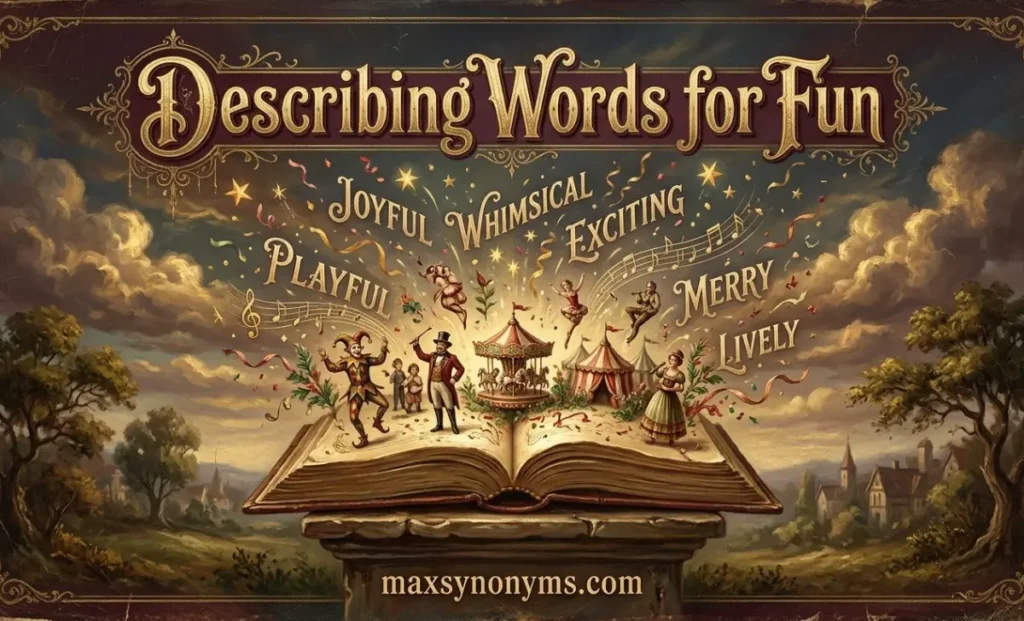
Adjectives can make a description more vivid by showing what made an experience enjoyable.
| Word | Meaning | Best use | Example |
|---|---|---|---|
| Enjoyable | Pleasant and satisfying | General situations | “The workshop was surprisingly enjoyable.” |
| Amusing | Funny or entertaining | A joke, story, or moment | “He told an amusing story about his first job.” |
| Entertaining | Interesting or enjoyable to watch or take part in | Performances and activities | “The host kept the guests entertained.” |
| Lively | Full of energy and activity | Parties and gatherings | “A lively band played in the town square.” |
| Playful | Light, cheerful, or not too serious | People, writing, and activities | “The dog gave her a playful nudge.” |
| Thrilling | Very exciting, sometimes intense | Rides, sports, or adventures | “The final lap was thrilling to watch.” |
Antonyms of Fun
There is no single opposite of fun that fits every use. The best choice depends on whether you mean “not enjoyable,” “serious,” or “boring.”
| Word | Meaning | Example |
|---|---|---|
| Boredom | The feeling of having little interest | “The long wait left the children in boredom.” |
| Tedium | The quality of being dull and repetitive | “She found the repeated task tedious.” |
| Misery | Great unhappiness or discomfort | “The cold rain turned the camping trip into misery.” |
| Seriousness | A lack of a light or playful mood | “The conversation shifted from fun to seriousness.” |
Boring is often the most direct opposite when describing an activity: “The game was fun” versus “The game was boring.” However, serious is a better contrast when you’re talking about tone rather than enjoyment.
Example Sentences
Here are natural ways to use fun and its alternatives in different situations:
- Everyday conversation: “We had a lot of fun trying the new café.”
- Talking about a funny moment: “Her impression of the teacher caused a great deal of amusement.”
- Describing an event: “The street festival offered live music and entertainment for all ages.”
- Writing about a hobby: “Cycling is an enjoyable way to explore the neighborhood.”
- Talking about children: “The playground gives kids room to play.”
- Describing an adventure: “Taking the wrong trail added excitement to the hike.”
- Professional or formal writing: “The team-building activity encouraged recreation and conversation.”
- Casual message: “Thanks for a fun evening—we should do it again soon.”
Difference Between Similar Words
Fun vs. enjoyment vs. amusement
| Word | Meaning / what it is | Main difference | Best use |
|---|---|---|---|
| Fun | A general word for pleasure or an enjoyable experience | Broad and informal | Daily conversation |
| Enjoyment | The feeling of liking something | Neutral and slightly more formal | General writing |
| Amusement | Enjoyment, often caused by something funny | Has a stronger connection to laughter | Comedy and humorous moments |
Quick rule: Use fun for a broad, casual description; enjoyment for the feeling of pleasure; and amusement when something makes people laugh or smile.
Fun vs. exciting vs. entertaining
Fun can describe almost any enjoyable experience. Exciting suggests energy, suspense, or anticipation. Entertaining usually describes something that holds your attention, such as a performance, film, or story.
For example, a quiet board game can be fun without being exciting. A film may be entertaining even if you don’t take part in it.
Best Alternative Words
| Situation | Best words | Why |
|---|---|---|
| Everyday conversation | Fun, good times, enjoyment | Natural and easy to understand |
| Professional writing | Enjoyment, recreation, entertainment | More specific and suitably neutral |
| Describing a comedy | Amusement, humor, entertaining | Highlights what is funny |
| Describing an energetic event | Excitement, lively, thrilling | Shows the energy or intensity |
| Writing about free-time activities | Recreation, play, enjoyment | Fits hobbies and leisure |
| Creative writing | Delight, merriment, adventure | Adds mood and detail |
Grammar Tips
Fun can be a noun or an adjective. It is generally uncountable when it means enjoyment:
- “We had fun at the festival.”
- “The kids had a lot of fun.”
- “The trip was great fun.”
Avoid using funs to mean several enjoyable experiences. Instead, say “fun activities,” “fun moments,” or “a lot of fun.”
As an adjective, fun comes before a noun:
- “It was a fun game.”
- “They organized a fun event.”
The comparative forms more fun and most fun are widely used: “This game is more fun” and “That was the most fun part.” The word funner also appears in informal speech, but more fun is a safer choice in formal writing.
Common Mistakes
| Wrong or less natural | Better choice | Reason |
|---|---|---|
| “We had many funs.” | “We had a lot of fun.” | Fun is usually uncountable in this meaning. |
| “The event was amusement.” | “The event was amusing” or “The event was entertaining.” | Amusement is a noun; amusing and entertaining describe the event. |
| “The activity was funner.” | “The activity was more fun.” | More fun is the safer form, especially in formal writing. |
| “The comedy was exciting.” | “The comedy was funny” or “The comedy was entertaining.” | Exciting suggests suspense or energy, not necessarily humor. |
Pro Writing Tips
Choose a synonym based on what made the experience enjoyable. If people laughed, amusing or entertaining may be clearer. If they felt energized, use exciting or thrilling. For a general statement, enjoyable is a reliable option.
Also consider your reader and the tone. Good times suits a casual message, while recreation fits a report or formal description.
Don’t choose a complicated word just to sound impressive. The clearest, most accurate word usually makes the strongest impression.
Related Words
These words connect to different kinds of enjoyment and leisure:
- Activities: games, hobbies, sports, crafts
- Social experiences: parties, gatherings, celebrations, outings
- Entertainment: comedy, music, movies, performances
- Feelings: joy, laughter, delight, pleasure
- Leisure: recreation, relaxation, free time, play
They are related to fun, but they are not all synonyms. For instance, a party can be fun, but the word party names an event rather than the feeling of enjoyment.
FAQs
What is a good synonym for fun?
Enjoyment is a useful general synonym. Choose amusement for something funny, excitement for something thrilling, and entertainment for a show or engaging activity.
What is another word for fun in a sentence?
It depends on the sentence. “We had fun” could become “We had a great time” or “We enjoyed ourselves.” For a more formal tone, try “We had an enjoyable evening.”
Is enjoyment the same as fun?
They are close, but not identical in tone. Fun is casual and can describe the activity or experience. Enjoyment usually names the feeling of pleasure.
Is amusement a synonym for fun?
Sometimes. Amusement works well when something is funny or entertaining. It is less suitable for an enjoyable but serious experience, such as completing a meaningful personal goal.
What is the opposite of fun?
Boring is a common opposite when describing an activity. Tedium describes something dull and repetitive, while misery refers to serious unhappiness or discomfort.
Is fun a noun or an adjective?
It can be both. In “We had fun,” it is a noun. In “That was a fun afternoon,” it is an adjective.
Can I say “funs”?
Usually not when you mean enjoyment. Say “a lot of fun” or name the separate experiences instead, such as “fun moments” or “fun activities.”
Is “more fun” correct?
Yes. More fun is common and works well in both conversation and writing. It is generally a safer choice than funner in formal contexts.
Conclusion
Fun is a handy word because it can describe many kinds of enjoyable experiences. Still, a more precise alternative can help readers picture what happened.
Use enjoyment or pleasure for the feeling of liking something, amusement when humor is involved, and entertainment for an engaging activity or performance.
If an experience feels energetic, excitement or thrill may fit better; for free-time activities, recreation is often more suitable.
The main point is to choose a word that matches the experience and the tone of your writing. In a casual message, fun or good times sounds natural.
In a report, enjoyable or recreation may be clearer. When in doubt, choose the simplest accurate word rather than a fancy substitute.
Read More Blogs:
- Synonyms for Beauty: Beautiful Words for Every Occasion
- Synonyms for Growth: Better Words for Every Context
- Synonyms for Motivation: Strong, Positive Words

I am Ali Hamza, a writer and language lover with four years of experience creating content about synonyms, vocabulary and English word usage. I like making words and meanings easier to understand through clear explanations and real-life examples.
As the author of maxsynonyms.com I focus on helping readers find synonyms improve their vocabulary and pick the right words for different situations. My goal is to provide easy-to-read content that helps students, writers, professionals and English learners.
Through maxsynonyms.com I am dedicated to sharing quality language tools that make learning English simple, interesting and available, to all.