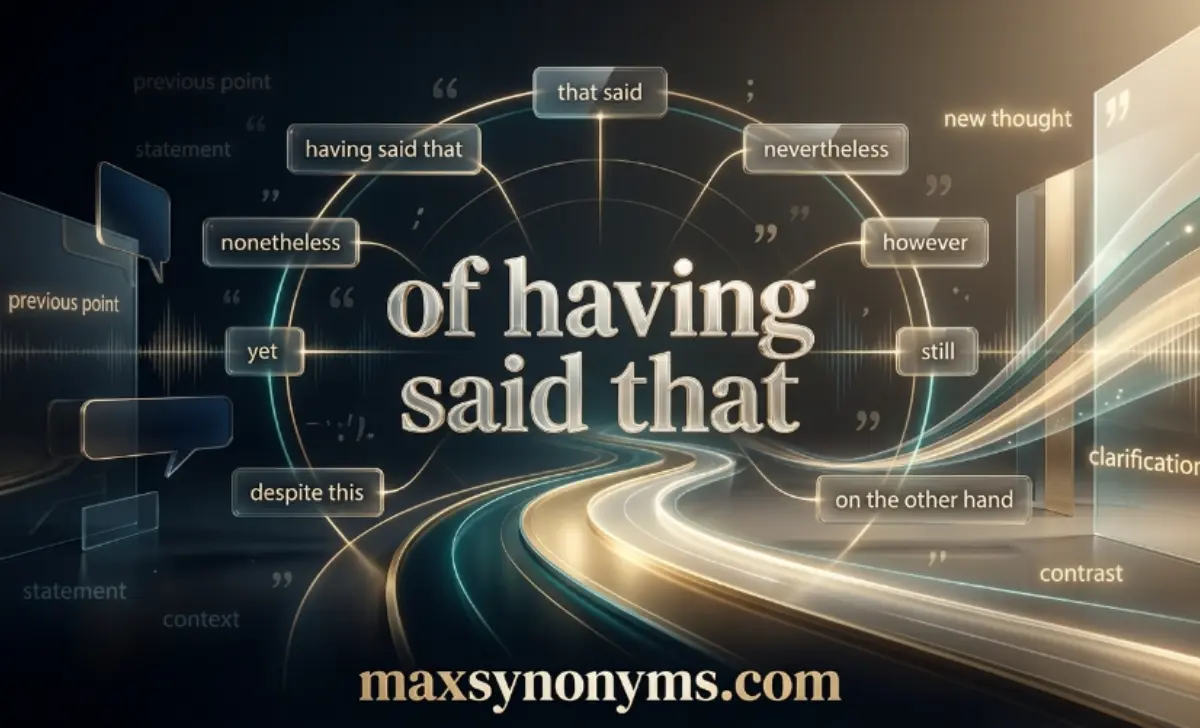
“Having said that” is a common English phrase used when you want to add a different point after making a previous statement. It often shows a contrast, qualification, or change in direction.
For example, you might say, “The hotel was expensive. Having said that, the service was excellent.” The first sentence gives one view, while the second adds another side.
One important point is that “having said that” is the natural phrase. “Of having said that” is not normally used as a standalone replacement. If you are looking for the meaning, grammar, synonyms, or better ways to say it, this guide will make the difference clear.
What Does “Having Said That” Mean?
Having said that means something like “despite what I just said,” “with that in mind,” or “even though that is true.”
It is used to introduce another thought that may seem different from, or slightly opposite to, the previous one.
Example:
The course is difficult. Having said that, it is very useful.
The speaker first says the course is difficult. Then they add a positive point.
In simple words, having said that = I have mentioned one point, but there is another point to consider.
Is “Of Having Said That” Correct?
Usually, no. If you want to use this transition phrase, the natural form is:
Having said that, …
Not:
Of having said that, …
The word of can appear before having said that in a different grammatical structure, but it does not normally form this common transition.
Natural:
Having said that, I still think it was a good decision.
Unnatural:
Of having said that, I still think it was a good decision.
So, if your focus is this expression, use having said that.
Can You Use “Having Said That” in a Sentence?
Yes. It is very common at the start of a sentence.
Examples:
- The restaurant was crowded. Having said that, the food was excellent.
- I do not agree with the plan. Having said that, I understand why you suggested it.
- The job is stressful. Having said that, I enjoy working with the team.
- The phone is expensive. Having said that, its camera is very good.
You can also place the phrase after a statement:
The movie was slow at times; having said that, I enjoyed the ending.
What Is Another Word for “Having Said That”?
There is no single word that always replaces having said that. Several phrases can work, depending on the tone and meaning.
Here are some useful alternatives:
1. That Said
Meaning: Despite the previous point.
The task was difficult. That said, we finished it on time.
2. That Being Said
Meaning: With the previous statement accepted or understood.
The plan has some risks. That being said, it could still work.
3. With That Said
Meaning: A transition to another related point.
The room is small. With that said, it is comfortable.
4. Having Said This
Meaning: After making the previous point, here is another point.
The book is quite long. Having said this, it is easy to read.
5. Even So
Meaning: Despite what was just mentioned.
The weather was terrible. Even so, we went hiking.
6. Nevertheless
Meaning: Despite that.
The task was challenging. Nevertheless, she completed it.
7. Nonetheless
Meaning: Despite what was said before.
The plan has a few problems. Nonetheless, it is worth trying.
8. However
Meaning: Used to introduce a contrasting idea.
The product is expensive. However, many customers like it.
9. Still
Meaning: Despite what has been said.
I know the journey is long. Still, I would like to go.
10. On the Other Hand
Meaning: Used to introduce a different side or view.
The apartment is small. On the other hand, it is close to work.
What Is a Better Way to Say “That Said”?
That said is already a good and natural phrase. However, you can choose another expression when you want a different tone.
| Phrase | Best for |
|---|---|
| Having said that | Natural conversation and writing |
| That said | Short and direct writing |
| That being said | Formal or careful tone |
| However | Essays and professional writing |
| Nevertheless | Formal writing |
| Nonetheless | Formal writing |
| Even so | Casual and natural English |
| On the other hand | Comparing two sides |
For most everyday situations, having said that and that said sound natural.
How to Professionally Say “With That Said”
If you want a more professional alternative, use:
- That said
- Having said that
- However
- Nevertheless
- Nonetheless
- With this in mind
- Despite this
- Even so
For example:
Casual:
The deadline is tight. With that said, we can finish the work.
Professional:
The deadline is tight. Nevertheless, we can complete the work.
However, do not assume that the most formal phrase is always the best. That said is short, clear, and perfectly suitable for many professional situations.
What Is a Fancy Way to Say “With That Being Said”?
If you want a more polished phrase, you can use:
- That being said
- Having said that
- Nevertheless
- Nonetheless
- With this in mind
- Despite this
- Even so
For formal writing, nevertheless and nonetheless can sound more formal.
Example:
The results were not perfect. Nevertheless, they were useful.
For normal conversation, however, having said that sounds more natural.
Another Way to Say “Said That”
If you mean the verb said, the best alternative depends on how the person spoke.
Some useful choices are:
- stated
- mentioned
- explained
- noted
- remarked
- commented
- reported
- declared
- claimed
- suggested
- argued
- pointed out
- replied
- answered
- added
- told
Examples
She said that the meeting was canceled.
You could write:
She stated that the meeting was canceled.
Or:
She explained that the meeting was canceled.
The meaning changes slightly, so these words should not be treated as perfect synonyms.
How Do You Say “Said” in a Formal Way?
For formal writing, stated is one of the most useful alternatives to said.
Other choices include:
- stated — gave information clearly
- noted — pointed something out
- explained — made something clear
- reported — gave information
- remarked — made a comment
- argued — gave a reason for a position
- declared — said something firmly
- claimed — said something was true
Example:
The researcher stated that more data was needed.
This sounds more formal than:
The researcher said that more data was needed.
What Are 10 Synonyms for “Said”?
Here are ten common alternatives:
- Stated
- Mentioned
- Explained
- Noted
- Remarked
- Commented
- Reported
- Declared
- Claimed
- Added
The best choice depends on the sentence. For example, claimed can suggest that the statement may not be proven, while stated is more neutral.
“Having Said That” vs “That Said”
These phrases are very close in meaning.
Having said that sounds a little more conversational and often refers clearly to something just mentioned.
The hotel was expensive. Having said that, the rooms were beautiful.
That said is shorter and often feels cleaner in writing.
The hotel was expensive. That said, the rooms were beautiful.
Both can work well. Your choice mainly depends on style and sentence flow.
“Having Said That” vs “That Being Said”
These phrases are also very similar.
Having said that:
The job is tiring. Having said that, I enjoy it.
That being said:
The job is tiring. That being said, I enjoy it.
Both introduce a contrasting or balancing thought. That being said can sound slightly more formal or deliberate, while having said that is very natural in everyday English.
“Having Said That” vs “However”
These are not always exact replacements.
However simply introduces a contrast:
The product is expensive. However, it is well made.
Having said that often refers back to something you just said:
The product is expensive. Having said that, I would still buy it.
The second phrase feels more like the speaker is balancing their own previous statement.
When Should You Use “Having Said That”?
Use it when you want to:
- add a different point;
- soften a previous opinion;
- show a contrast;
- acknowledge one fact before giving another;
- balance a negative point with a positive one;
- move from one side of an argument to another.
For example:
The exam was hard. Having said that, it was fair.
The phrase helps the reader understand that both ideas are true.
“Having Said That” in Academic Writing
You can use having said that in academic writing, but it may sound more conversational than some formal alternatives.
For a formal essay, you may prefer:
- however
- nevertheless
- nonetheless
- despite this
- even so
- on the other hand
Less formal:
The study has some limits. Having said that, its findings are useful.
More formal:
The study has some limitations. Nevertheless, its findings are useful.
Both are understandable. The second simply has a more academic tone.
“Having Said That” in Professional Emails
The phrase can work well in emails when you want to disagree politely or add another point.
Example:
The current system is not perfect. Having said that, it has helped us reduce errors.
Another example:
I understand that the deadline is important. Having said that, we may need one more day to complete the work properly.
It helps you sound balanced rather than overly negative.
Common Mistakes With “Having Said That”
Mistake 1: Adding “of”
Of having said that, I agree with you.
Better:
Having said that, I agree with you.
Mistake 2: Using it without a previous idea
The phrase normally works best when something has already been said or written.
Having said that, the weather is nice.
This can feel odd if there is no earlier point to contrast.
Mistake 3: Treating every synonym as identical
However, nevertheless, even so, and on the other hand can all show contrast, but they do not always carry the same tone.
Choose the phrase that matches your sentence.
What Does “You Should Have Said That” Mean?
This is a different expression from having said that.
You should have said that means the person thinks you ought to have mentioned something earlier.
For example:
“I have a spare ticket.”
“You should have said that earlier!”
Here, the speaker means, “You should have told me this before.”
It can express mild frustration, surprise, or regret.
What Is Meant When It Is Said That?
The phrase “when it is said that” introduces an idea or statement that someone has expressed.
For example:
When it is said that exercise improves health, it means that regular activity can have positive effects on the body.
It is different from having said that.
- When it is said that = refers to a statement or claim.
- Having said that = introduces a different or balancing point after a previous statement.
Best Alternatives by Situation
| Situation | Best choice |
|---|---|
| Everyday English | Having said that |
| Short writing | That said |
| Formal writing | Nevertheless |
| Academic writing | However / Nevertheless |
| Professional email | That said / However |
| Strong contrast | Nevertheless |
| Casual contrast | Even so |
| Two different sides | On the other hand |
| Referring to a previous point | Having said that |
| Adding a balanced thought | That being said |
FAQs About “Having Said That”
What is another word for “having said that”?
Common alternatives include that said, that being said, with that said, having said this, however, nevertheless, nonetheless, and even so.
Is “having said that” grammatically correct?
Yes. Having said that is a correct and common English expression. It is usually used to introduce a contrasting or balancing idea.
Is “of having said that” correct?
Not as the normal transition phrase. The natural expression is having said that.
Can you use “having said that” in a sentence?
Yes.
The project is expensive. Having said that, it could save money later.
What is a better way to say “that said”?
Depending on the context, use having said that, however, nevertheless, nonetheless, even so, or that being said.
How do you professionally say “with that said”?
In professional writing, you can use that said, however, nevertheless, nonetheless, or with this in mind.
What is another way to say “said that”?
Depending on the meaning, use stated, mentioned, explained, noted, reported, remarked, claimed, or declared.
What is a formal word for “said”?
Stated is one of the safest formal alternatives. Other options include noted, explained, reported, declared, and remarked.
What is a fancy way to say “with that being said”?
For a more formal style, try nevertheless, nonetheless, however, or with this in mind.
Final Thoughts
Having said that is a useful phrase when you want to balance one idea with another. It often means “despite what I just said” or “there is another point to consider.”
Remember that “of having said that” is not the normal form of this expression. Use “having said that” instead.
For a shorter option, choose that said. For formal writing, however, nevertheless, or nonetheless may fit better. And when you simply need another word for said, choose a verb such as stated, explained, noted, or mentioned based on the exact meaning.
Read More Blogs:
- Rendition Synonyms: Better Words for Every Context
- Reluctant Synonyms: 50 Better Words for Hesitation

I am Ali Hamza, a writer and language lover with four years of experience creating content about synonyms, vocabulary and English word usage. I like making words and meanings easier to understand through clear explanations and real-life examples.
As the author of maxsynonyms.com I focus on helping readers find synonyms improve their vocabulary and pick the right words for different situations. My goal is to provide easy-to-read content that helps students, writers, professionals and English learners.
Through maxsynonyms.com I am dedicated to sharing quality language tools that make learning English simple, interesting and available, to all.