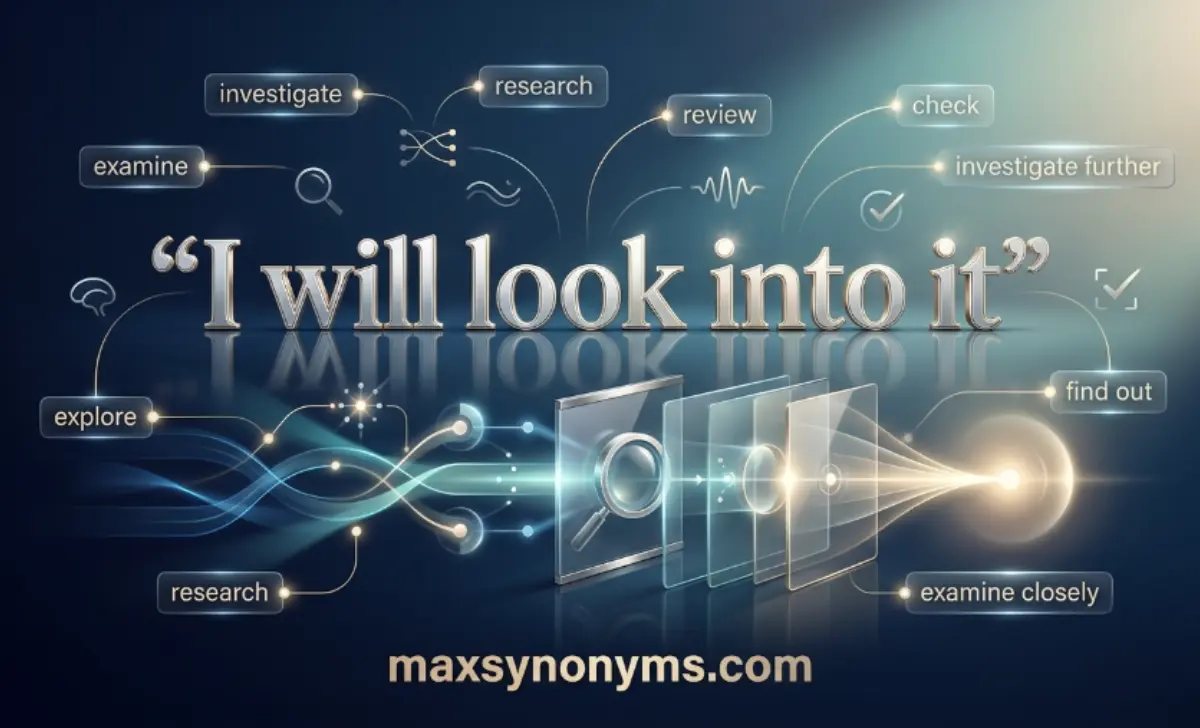
Have you ever received a question or problem and needed time before giving an answer? You may have said, “I will look into it.” This simple phrase is common in everyday English and workplace communication.
“I will look into it” means that you will check, examine, or investigate something before giving an answer or taking action. For example, if a customer reports a problem, you might say, “I will look into it and get back to you.”
The phrase works well in casual conversations, emails, and professional settings. However, you may sometimes want a more formal or specific expression. Knowing different ways to say it can help students, bloggers, content writers, and daily English users sound more natural and confident.
What Does “I Will Look Into It” Mean?
“I will look into it” means “I will check or investigate it.”
The phrase tells someone that you plan to learn more about a question, problem, request, or situation.
For example:
- “The payment has not arrived yet. I will look into it.”
- “I will look into the issue and let you know what I find.”
Here, look into is a phrasal verb. It does not mean simply looking at something with your eyes. It means giving something attention so you can understand it or find an answer.
Is “I Will Look Into It” Correct?
Yes, “I will look into it” is grammatically correct and natural English.
It can be used in both spoken and written English. The phrase is also suitable for many professional situations.
For example:
“Thank you for bringing this to my attention. I will look into it.”
You can also use the shorter form:
“I’ll look into it.”
Both forms have the same basic meaning. “I’ll look into it” sounds slightly more conversational, while “I will look into it” can add a little more emphasis.
What Does “To Look Into” Mean?
To look into something means to examine, check, or investigate it carefully.
The phrase is often used when you need more information before making a decision.
For example:
- “The manager will look into the complaint.”
- “Can you look into this problem?”
The object usually comes after look into, such as the issue, the matter, the problem, this request, or it.
What Is a Formal Word for “Look Into”?
The best formal alternatives depend on the situation. Common choices include:
- Investigate — examine a problem or situation carefully.
- Examine — study something closely.
- Review — check something carefully.
- Assess — judge or evaluate something.
- Consider — think about something before deciding.
- Explore — examine an idea or possibility.
- Verify — check that information is correct.
- Evaluate — judge the value, quality, or effect of something.
For example, instead of saying:
“I will look into the complaint.”
You could say:
“I will investigate the complaint.”
For a workplace email, review, investigate, or examine can sound more formal than look into.
What Is a Better Way to Say “Look Into”?
There is no single better replacement. The right phrase depends on what you mean.
| Phrase | Best use |
|---|---|
| I’ll check | Simple and casual |
| I’ll review it | Documents, work, or information |
| I’ll investigate it | Problems or complaints |
| I’ll examine the matter | Formal situations |
| I’ll look into the issue | General professional use |
| I’ll verify the information | Checking facts |
| I’ll assess the situation | Judging a situation |
| I’ll explore the options | Ideas or choices |
For most workplace situations, “I’ll look into it” is already clear and professional.
How Do You Say “Look Into” Professionally?
You can replace look into with a more precise verb when needed.
For example:
- “I will review the report.”
- “I will investigate the issue.”
- “I will examine the matter.”
- “I will verify the details.”
- “I will assess the situation.”
- “I will consider your request.”
If you do not know exactly which verb fits, “I will look into it” remains a safe and natural choice.
How Do I Say “I Will Look Into This Matter”?
There are several natural ways to express this idea:
- “I will look into this matter.”
- “I will investigate this matter.”
- “I will review the matter.”
- “I will examine the issue.”
- “I will look into the issue and get back to you.”
- “I will investigate the matter and update you.”
- “I will review this and let you know.”
“I will look into this matter” is more formal than simply saying “I will look into it.”
How Can I Say “Please Look Into This” Professionally?
If you want someone to check a problem without sounding too direct, try these alternatives:
- “Could you please look into this?”
- “Could you please review this matter?”
- “Would you please investigate this issue?”
- “Could you kindly examine this issue?”
- “Please review this matter when you have a moment.”
- “I would appreciate it if you could look into this.”
- “Could you please check this and let me know?”
For a professional email, “Could you please look into this?” is polite, clear, and natural.
How Do You Say “Please Look Into It” Professionally?
The simplest professional version is:
“Could you please look into it?”
Other options include:
“Could you please review the matter?”
“Would you kindly investigate this issue?”
“Could you please check this and let me know?”
“I would appreciate it if you could look into this.”
The last option is useful when you want your request to sound especially polite.
What Is Another Word for “Into It”?
There is not always one direct replacement for “into it.” The best alternative depends on the sentence.
For example:
- about it
- regarding it
- concerning it
- on it
- at it
- with it
However, these expressions do not always have the same meaning.
For “I will look into it,” you should not simply replace into with another preposition. The natural alternatives are complete phrases such as:
- “I will check it.”
- “I will review it.”
- “I will investigate it.”
- “I will examine it.”
How Do You Say “Have a Look” in Different Ways?
“Have a look” means to look at or check something.
Depending on the situation, you can say:
- Take a look.
- Have a look.
- Check it out.
- Look at this.
- Review it.
- Examine it.
- Take a quick look.
- Please check this.
- Could you review this?
- Could you take a look?
For casual English, “Take a look” and “Check it out” are common.
For professional writing, “Could you please review this?” is often a better choice.
What Does the Phrase “I’ll Look” Mean?
“I’ll look” means “I will look at something” or “I will check something,” depending on the context.
The meaning is not always complete without more information.
For example:
“I’ll look at the report.”
This means the person will examine the report.
But:
“I’ll look into the issue.”
means the person will investigate the issue.
So, look at and look into are not always interchangeable.
“Look Into” vs. “Look At”
These two phrases are related, but they can have different meanings.
Look at usually means to direct your attention toward something or examine it.
“Please look at this document.”
Look into often means to investigate or find out more about something.
“Please look into this complaint.”
If you simply need someone to see something, use look at. If you want them to investigate it, look into is usually better.
What Can I Say Instead of “Look Into”?
Here are useful alternatives:
- Check
- Review
- Investigate
- Examine
- Assess
- Evaluate
- Verify
- Explore
- Consider
- Research
Not every word fits every situation. Investigate is stronger than check, while review is often best for documents or work.
How Can I Say “Will Do” Professionally?
“Will do” means “I will do it” or “I will take care of it.”
It is common in casual workplace communication, but you can use more specific alternatives in formal writing:
- “Certainly. I will take care of it.”
- “I will handle this.”
- “I will take care of the matter.”
- “I will complete it.”
- “I will proceed with this.”
- “I will take the necessary steps.”
- “I’ll get this done.”
For example:
“Could you send the revised file today?”
“Certainly. I will take care of it.”
This sounds professional while still being friendly.
“I Will Look Into It” vs. “I Will Check It”
These phrases are close, but they can suggest different levels of attention.
I will check it usually means you will quickly verify or inspect something.
“I will check the schedule.”
I will look into it often suggests that you will investigate a problem or find more information.
“I will look into the missing payment.”
If a situation needs research or investigation, look into it is usually the better choice.
“I Will Look Into It and Get Back to You”
This is a very useful professional expression.
It means:
“I will investigate or check the matter, then contact you again with an answer.”
For example:
“I’m not sure why the order was delayed, but I will look into it and get back to you.”
This wording is useful in customer service, workplace emails, and business communication because it shows that you will follow up.
Is “I Will Look Into It” Professional?
Yes. “I will look into it” can be professional, polite, and appropriate for workplace communication.
It works well when you need time to check something before answering.
For example:
“Thank you for reporting the issue. I will look into it and update you shortly.”
However, when writing a very formal message, a more specific verb may be stronger:
“I will investigate the issue and provide an update.”
The best choice depends on the tone and situation.
Professional Alternatives to “I Will Look Into It”
Here are some ready-to-use alternatives:
- “I will review this and get back to you.”
- “I will investigate the matter.”
- “I will examine the issue.”
- “I will check the details.”
- “I will verify the information.”
- “I will assess the situation.”
- “I will look into this and provide an update.”
- “I will review the request and respond shortly.”
These options help you avoid repeating the same phrase in emails and conversations.
Another Way of Saying “I Look Up to You”
“I look up to you” has a completely different meaning from “I look into it.”
I look up to you means I admire and respect you.
For example:
“I look up to my teacher because she always helps her students.”
Other ways to express this idea include:
- I admire you.
- I respect you.
- I have great respect for you.
- You are someone I admire.
- I value your example.
- You inspire me.
So, do not confuse look into with look up to. They are different phrasal verbs with different meanings.
Examples of “I Will Look Into It”
Here are some natural examples from everyday and professional situations:
- “I will look into the issue this afternoon.”
- “I’ll look into the payment problem.”
- “Thank you for letting me know. I will look into it.”
- “I’ll look into the matter and get back to you.”
- “I will look into your request.”
- “Let me look into this for you.”
- “I’ll look into the problem and find out what happened.”
- “I will look into the details before making a decision.”
These examples show how flexible the phrase can be.
When Should You Use “I Will Look Into It”?
Use this phrase when you need to check, investigate, research, or understand something before responding.
It is useful when:
- Someone reports a problem.
- A customer asks a question.
- You need to check information.
- You need to review a document.
- You need to find out what happened.
- You need more time before giving an answer.
- You need to investigate a request.
For example, if a colleague asks why a report is missing, you can say:
“I will look into it and let you know.”
This gives a clear and helpful response without making a promise about the final result.
Final Thoughts
“I will look into it” is a correct, natural, and useful English phrase. It means that you will check or investigate something before giving an answer.
It works in daily conversations, emails, customer service, and workplace communication.
When you need a more formal tone, you can use words such as review, investigate, examine, verify, or assess.
Learning these alternatives gives you more control over your writing and helps you avoid repeating the same phrase.
Practice them in emails, essays, work messages, and daily conversations to make your English clearer and more flexible.
Read More Blogs:

I am Ali Hamza, a writer and language lover with four years of experience creating content about synonyms, vocabulary and English word usage. I like making words and meanings easier to understand through clear explanations and real-life examples.
As the author of maxsynonyms.com I focus on helping readers find synonyms improve their vocabulary and pick the right words for different situations. My goal is to provide easy-to-read content that helps students, writers, professionals and English learners.
Through maxsynonyms.com I am dedicated to sharing quality language tools that make learning English simple, interesting and available, to all.