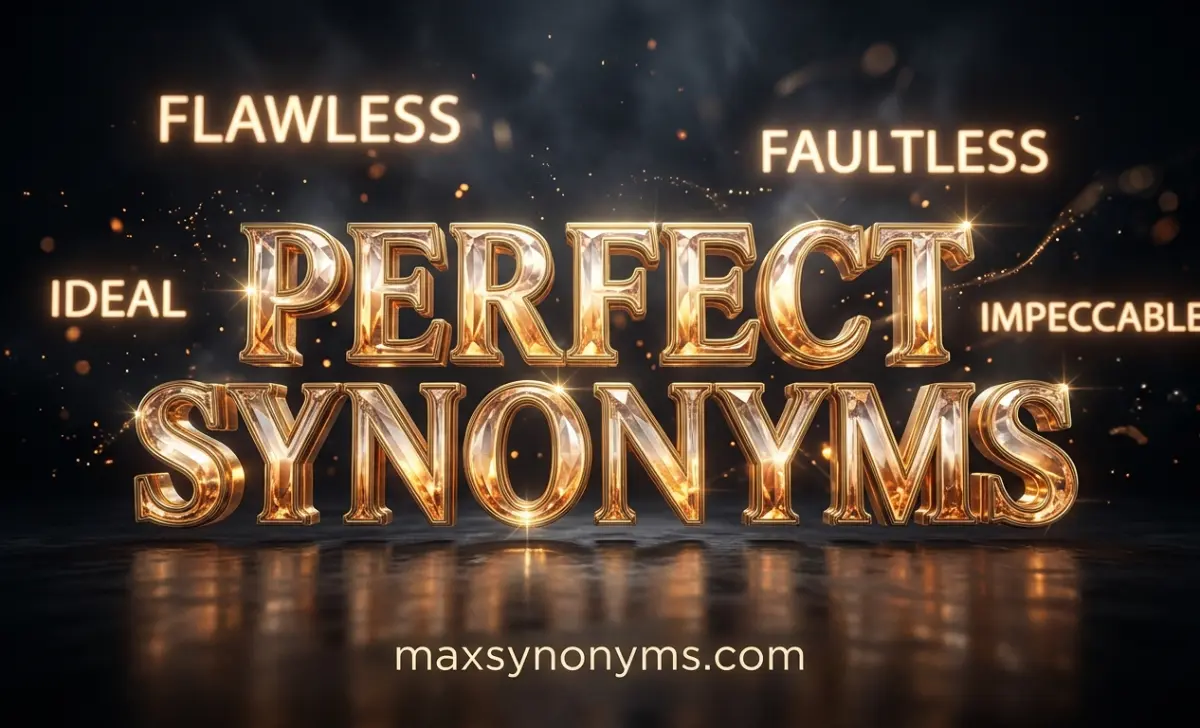
The word “perfect” is useful when something meets every expectation, but it is not always the best choice.
Sometimes, a more specific word can make your writing clearer, more natural, and more interesting.
For example, ideal describes something suitable, while flawless emphasizes the absence of mistakes.
Whether you are writing a professional email, complimenting someone, or chatting with a friend, choosing the right synonym can improve your message.
This guide explores perfect synonyms for formal writing, casual English, people, and everyday situations.
You will also find antonyms, five-letter alternatives, words beginning with P, and practical examples to help you use each word correctly.
Quick Answer
The best synonym for “perfect” depends on what you want to describe. Here are some common alternatives and their uses.
| Synonym | Meaning or best use | Example |
|---|---|---|
| Ideal | Best suited to a purpose | This is the ideal location for our office. |
| Flawless | Without mistakes or defects | She gave a flawless performance. |
| Excellent | Very high quality | Your presentation was excellent. |
| Impeccable | Without faults, especially in style or conduct | He has impeccable manners. |
| Exceptional | Unusually good | She delivered exceptional results. |
| Outstanding | Noticeably better than average | His work was outstanding. |
| Spot-on | Exactly right; informal | Your answer was spot-on. |
| Exemplary | Worthy of imitation | She showed exemplary leadership. |
| Unmatched | Not equaled by others | The service was unmatched. |
| Optimal | Best under particular conditions | We found the optimal solution. |
For general use, ideal is a versatile choice. However, flawless works better when you mean something has no errors, while excellent expresses strong approval. In formal situations, impeccable can sound more polished.
What Does Perfect Mean?
“Perfect” is an adjective that describes something without faults, something that meets a high standard, or something especially suitable for a particular purpose.
The exact meaning depends on the context. For example:
- Without mistakes: The editor produced a perfect copy.
- Exactly suitable: Saturday is the perfect day for a picnic.
- Very high quality: The chef prepared a perfect meal.
- Complete agreement: “Can we meet at 10 a.m.?” “Perfect!”
In everyday conversations, people often use “perfect” to show that they agree with a suggestion. In other situations, the word describes quality or suitability. Understanding this difference makes it easier to choose an accurate synonym.
Best Synonyms for Perfect
Several words share the meaning of “perfect,” but each highlights a slightly different quality.
Ideal
Ideal describes something that is especially suitable for a particular need or situation. It does not necessarily mean that the thing has no flaws.
Example: This quiet room is ideal for studying.
Flawless
Use flawless when something has no noticeable mistakes, defects, or weaknesses. It is particularly useful for describing performances, work, and execution.
Example: The team delivered a flawless presentation.
Excellent
Excellent is a flexible word that expresses high quality. Unlike “flawless,” it does not necessarily suggest that something is completely free from errors.
Example: Your explanation was excellent and easy to understand.
Impeccable
Impeccable sounds polished and slightly formal. It often describes manners, taste, service, appearance, or professional standards.
Example: The receptionist maintained impeccable professionalism.
Exceptional
Something exceptional stands out because it is unusually good or impressive. Therefore, this word is useful when praising ability, performance, or results.
Example: Her exceptional problem-solving skills helped the team succeed.
Outstanding
Use outstanding for work, achievements, or performances that stand above the usual standard.
Example: He received an award for outstanding customer service.
Exemplary
Exemplary describes behavior or performance that others can learn from or imitate.
Example: The manager demonstrated exemplary leadership during the crisis.
Optimal
Optimal means the best or most effective option under particular conditions. It is common in technical, academic, and business writing.
Example: The researchers identified the optimal temperature for the experiment.
Perfect Synonyms for Different Situations
A synonym that works in one sentence may sound unnatural in another. For that reason, consider what you are describing before replacing “perfect.”
| Situation | Suitable synonyms | Example |
|---|---|---|
| A plan or solution | Ideal, optimal, effective | This is the ideal solution for our budget. |
| A performance | Flawless, outstanding, exceptional | The singer gave an outstanding performance. |
| A person’s behavior | Impeccable, exemplary, admirable | Her conduct was exemplary. |
| A piece of work | Excellent, polished, faultless | The report is polished and professional. |
| A match or fit | Ideal, suitable, just right | This role is ideal for him. |
| A result | Excellent, remarkable, exceptional | The campaign achieved exceptional results. |
| A casual response | Great, brilliant, spot-on | Perfect! Let’s meet after lunch. |
| A technical process | Optimal, precise, error-free | The system uses an optimal configuration. |
These alternatives help you express your meaning more precisely. For instance, precise emphasizes accuracy, whereas exceptional highlights unusually high quality. As a result, choosing the right word can make your writing more informative.
Perfect Synonyms in Slang and Casual English
In informal conversations, relaxed expressions often sound more natural than formal adjectives. These alternatives are useful when chatting with friends or responding to everyday suggestions.
- Spot-on: Exactly right. “Your guess was spot-on.”
- On point: Very good or appropriate. “Your outfit is on point.”
- Nailed it: Did something successfully. “You nailed that presentation.”
- Ace: Perform extremely well. “She aced the interview.”
- Awesome: Extremely good or exciting. “That concert was awesome.”
- Top-notch: Of excellent quality. “The restaurant provides top-notch service.”
- Just right: Exactly suitable. “The temperature is just right.”
- Bang-on: Exactly correct, especially in British and some other varieties of English. “Your timing was bang-on.”
However, these expressions do not all mean precisely the same thing. “Nailed it” describes successful performance, while “spot-on” usually emphasizes accuracy. Similarly, “awesome” expresses enthusiasm rather than literal perfection.
For a casual message, you could say, “That sounds perfect!” Alternatively, try “Sounds great,” “That works for me,” or “Spot-on choice.”
Formal and Classy Words for Perfect
Professional emails, reports, and academic writing often benefit from precise vocabulary. Instead of repeating “perfect,” choose a word that reflects the quality you want to emphasize.
| Word | Best context | Example |
|---|---|---|
| Impeccable | Conduct, taste, or service | Her attention to detail was impeccable. |
| Exemplary | Behavior worth copying | The employee showed exemplary commitment. |
| Superlative | Extremely high quality | The restaurant is known for superlative service. |
| Peerless | Without an equal | The artist has a peerless command of color. |
| Unparalleled | Not matched in a particular respect | The program offers unparalleled access to resources. |
| Optimal | The most effective option under given conditions | We selected the optimal approach. |
| Faultless | Free from errors or shortcomings | The proposal was faultless in its execution. |
| Pristine | Clean, untouched, or undamaged | The equipment remained in pristine condition. |
A classy word does not have to be complicated. In most situations, impeccable or exceptional sounds more natural than an obscure term chosen only to impress.
Consider these alternatives:
- Everyday: “Your work is perfect.”
- Professional: “Your work is excellent.”
- Polished: “Your attention to detail is impeccable.”
- Achievement-focused: “Your results are exceptional.”
As you can see, the strongest choice depends on the message and audience.
Synonyms for a Perfect Person
When describing a person, focus on the qualities you admire. Calling someone “perfect” can sound exaggerated, while a more specific adjective gives your compliment greater meaning.
| Synonym | What it emphasizes | Example |
|---|---|---|
| Exceptional | Remarkable qualities or abilities | She is an exceptional mentor. |
| Admirable | Qualities deserving respect | He showed admirable patience. |
| Exemplary | Behavior worth following | She is an exemplary team leader. |
| Outstanding | Achievements or performance | He is an outstanding student. |
| Virtuous | Strong moral character | The story portrays a virtuous character. |
| Ideal | Suitability for a role or purpose | She would be an ideal candidate. |
| Remarkable | Something unusual or impressive | He is a remarkable problem-solver. |
| Inspiring | The ability to motivate others | She is an inspiring teacher. |
Each word highlights a different trait. For example, virtuous focuses on moral character, while outstanding usually describes performance or achievement. Neither term suggests that a person never makes mistakes.
Real-life example:
Imagine a colleague who supports the team, solves problems, and treats everyone fairly. Rather than simply calling this person perfect, you could describe them as an admirable colleague or an exemplary leader.
These expressions explain what makes the person valuable without suggesting that anyone is completely free from flaws.
What Is a Word Beyond Perfect?
There is no single word that is always stronger than “perfect.” Nevertheless, certain alternatives can express extraordinary quality, unmatched ability, or an experience that goes beyond the ordinary.
- Transcendent: Going beyond ordinary limits or experience.
- Peerless: Having no equal.
- Unequaled: Not matched by anything comparable.
- Unparalleled: Better than anything comparable in a particular respect.
- Superlative: Of the highest degree or quality.
- Extraordinary: Far beyond what is usual.
- Matchless: So outstanding that it has no equal.
For example, “The musician gave an extraordinary performance” suggests something remarkable. Meanwhile, “Her expertise is unparalleled” emphasizes that others do not match her level of expertise.
In creative writing, transcendent can describe an experience that seems to go beyond ordinary description. By contrast, exceptional or unparalleled may be clearer choices in professional writing.
Perfect Synonyms That Start With P
If you need a synonym beginning with P, several words can express excellence, suitability, or a lack of flaws.
| Word | Meaning | Example |
|---|---|---|
| Pristine | Clean, untouched, or in excellent original condition | The artifact remained in pristine condition. |
| Peerless | Without an equal | She is a peerless performer. |
| Prime | Of the best quality or greatest importance | This is a prime example of good design. |
| Premier | First in importance or quality | The city has a premier research center. |
| Precise | Exact and accurate | His instructions were precise. |
| Polished | Refined or skillfully presented | She delivered a polished speech. |
| Proficient | Skilled or competent | He is proficient in several languages. |
Keep in mind that these words are related to different aspects of quality. Precise emphasizes accuracy, proficient describes skill, and pristine focuses on condition. Therefore, none is a universal replacement for “perfect.”
Five-Letter Synonyms for Perfect
Short alternatives can be helpful for word games, captions, or writing with a strict length limit. However, five-letter words rarely match every meaning of “perfect.”
| Word | Meaning | Example |
|---|---|---|
| Ideal | Best suited to a purpose | It is an ideal choice. |
| Prime | Excellent or important | This is a prime example. |
| Exact | Completely accurate or matching | That is the exact answer. |
| Super | Excellent; informal | You did a super job. |
Of these options, ideal and prime can work as alternatives in certain contexts. Meanwhile, exact emphasizes accuracy, and super is informal praise. Always consider the sentence before choosing a short synonym.
Perfect Antonyms: Words With the Opposite Meaning
An antonym expresses an opposite or contrasting idea. Since “perfect” can describe quality, suitability, or the absence of faults, its best antonym depends on the context.
| Antonym | Meaning | Example |
|---|---|---|
| Flawed | Having a defect or weakness | The plan had a flawed assumption. |
| Imperfect | Not completely free from faults | The result was imperfect but useful. |
| Defective | Having a fault that affects function | The customer returned the defective device. |
| Faulty | Not working or reasoning correctly | The test relied on faulty equipment. |
| Inadequate | Not good enough for a need | The evidence was inadequate. |
| Unsuitable | Not appropriate for a purpose | Those shoes are unsuitable for hiking. |
| Inferior | Lower in quality or standard | The replacement material was inferior. |
| Substandard | Below the expected standard | The inspection found substandard work. |
For example, the opposite of “a perfect fit” might be “a poor fit.” However, “a defective machine” is a better contrast when discussing a machine that does not work correctly. The intended meaning determines the most accurate antonym.
Perfect vs. Excellent vs. Flawless
Although these words are closely related, each emphasizes something different.
| Word | Main emphasis | Example |
|---|---|---|
| Perfect | Meets an ideal standard or is exactly suitable | This is the perfect gift for her. |
| Excellent | Very high quality | The gift was of excellent quality. |
| Flawless | Has no noticeable mistakes or defects | The gift’s finish was flawless. |
Imagine that a student gives a presentation. You might call it excellent if it is engaging and well organized. If the delivery contains no noticeable mistakes, flawless may be more accurate. Meanwhile, perfect could describe a presentation that meets every requirement and suits the occasion exactly.
In everyday English, people sometimes use these words interchangeably for emphasis. In more precise writing, however, their differences help communicate the intended meaning.
How to Use Perfect Synonyms in Everyday Writing
Choosing an accurate alternative can improve emails, feedback, applications, and everyday conversations. First, identify the quality you want to express. Then select a word that describes it clearly.
For professional feedback
Instead of writing, “Your report is perfect,” consider these alternatives:
- “Your report is clear and well organized.”
- “The report is excellent and addresses all the key points.”
- “Your attention to detail is impeccable.”
Specific feedback explains what the reader did well. As a result, it often sounds more genuine than a general compliment.
For a recommendation
Rather than saying, “She is the perfect candidate,” you could write, “She is an ideal candidate for the role because her experience matches the team’s needs.”
For casual conversation
Suppose a friend suggests a restaurant. You could reply, “That sounds great,” “That works perfectly,” or “Spot-on choice.” Each response sounds friendly without being overly formal.
For creative writing
Instead of repeatedly describing a place as perfect, choose a more descriptive word. For example, idyllic can describe a peaceful, picturesque setting, while pristine suggests an untouched environment. Similarly, remarkable works when something inspires admiration.
These choices add useful detail rather than simply making the praise sound stronger.
Common Mistakes When Choosing a Synonym for Perfect
Even words with similar meanings can sound unnatural when used in the wrong context. Avoid these common mistakes to make your writing clearer.
- Using “flawless” when you mean suitable: “This is a flawless day for a picnic” may sound unusual if you are talking about the weather and timing. Instead, “This is an ideal day for a picnic” is more natural.
- Using “optimal” for a personal compliment: “You look optimal” is not a natural everyday compliment. In this situation, “You look great” fits better.
- Treating “excellent” as error-free: Excellent work can still contain minor mistakes. Therefore, use “flawless” when the absence of errors is especially important.
- Choosing formal words for casual messages: “Your suggestion is unparalleled” may sound overly grand when “That’s a great idea” would work better.
- Assuming a perfect person has no weaknesses: When describing people, use specific words such as kind, reliable, talented, or admirable instead of suggesting that anyone has no flaws.
Ultimately, the goal is not to choose the fanciest synonym. Instead, select a word that communicates your meaning accurately and naturally.
Frequently Asked Questions
What is a synonym for perfect?
Common synonyms include ideal, flawless, excellent, impeccable, exceptional, and outstanding. The best choice depends on what you want to describe.
What is a fancy word for perfect?
Impeccable, peerless, superlative, and unparalleled can sound formal or sophisticated. However, use them only when their meanings fit your sentence.
What is a synonym for “very great”?
Depending on the context, try exceptional, extraordinary, outstanding, remarkable, or superb. For example, “She did an outstanding job” sounds natural in professional feedback.
What are 10 synonyms for awesome?
Ten alternatives are amazing, excellent, fantastic, incredible, marvelous, superb, outstanding, phenomenal, remarkable, and exceptional. Although these words express strong praise, their tone and intensity vary.
What word is greater than perfect?
No single word is always greater than “perfect.” However, extraordinary, transcendent, peerless, and unparalleled can communicate exceptional qualities in suitable contexts.
What is a classy word for great?
Superb, exceptional, impeccable, and distinguished can sound polished. For example, “The restaurant offers superb service” is concise and professional.
How do you say perfect in a fancy way?
Try impeccable for faultless quality, peerless for something without an equal, or superlative for the highest degree of quality. Choose according to the sentence.
What are some perfect synonyms for a person?
Admirable, exceptional, outstanding, exemplary, and inspiring are useful when describing a person’s qualities. Choose the word that best reflects the trait you want to highlight.
What is the difference between perfect and ideal?
“Perfect” often suggests having no faults or meeting an ideal standard. In contrast, “ideal” means best suited to a particular purpose or situation. An ideal choice may be practical and suitable without being literally flawless.
What is the opposite of perfect?
Common antonyms include imperfect, flawed, defective, faulty, and inadequate. The most accurate opposite depends on the context.
Conclusion
The best synonym for “perfect” is the one that expresses your intended meaning. Use ideal for suitability, flawless for the absence of errors, excellent for high quality, and impeccable for polished standards.
In casual conversations, expressions such as spot-on, awesome, and just right can sound more natural.
For professional writing, exceptional, exemplary, or optimal may be better choices when they accurately describe the situation.
Similarly, when praising a person, focus on qualities that make them admirable rather than suggesting that they have no flaws.
Ultimately, a well-chosen synonym does more than replace a word. It helps your message sound clear, specific, and appropriate for your reader.
Read More Blogs:
- Intelligence Synonyms: Intellect, Acumen, Wit, and More
- Nice to Have Synonyms: Better Words to Use
- As You Know: Meaning, Synonyms, and Better Alternatives

I am Ali Hamza, a writer and language lover with four years of experience creating content about synonyms, vocabulary and English word usage. I like making words and meanings easier to understand through clear explanations and real-life examples.
As the author of maxsynonyms.com I focus on helping readers find synonyms improve their vocabulary and pick the right words for different situations. My goal is to provide easy-to-read content that helps students, writers, professionals and English learners.
Through maxsynonyms.com I am dedicated to sharing quality language tools that make learning English simple, interesting and available, to all.