Have you ever described something as scary but felt that the word did not fully capture what you meant? A horror movie, an abandoned house, and a threatening person can all be scary, yet each may call for a different word.
Choosing the right alternative helps readers picture the feeling more clearly.
Scary synonyms include words such as frightening, creepy, spooky, and terrifying. However, these words are not interchangeable in every situation.
Some describe intense fear, while others suggest something strange, dangerous, or unsettling.
The right choice depends on what you want to describe and how strongly you want to express it.
This guide covers useful alternatives, slang expressions, stronger words, antonyms, and examples. You will also learn how to describe a scary-looking person or something that feels both creepy and beautiful.
What Does Scary Mean?
Before choosing an alternative, it helps to understand the original word.
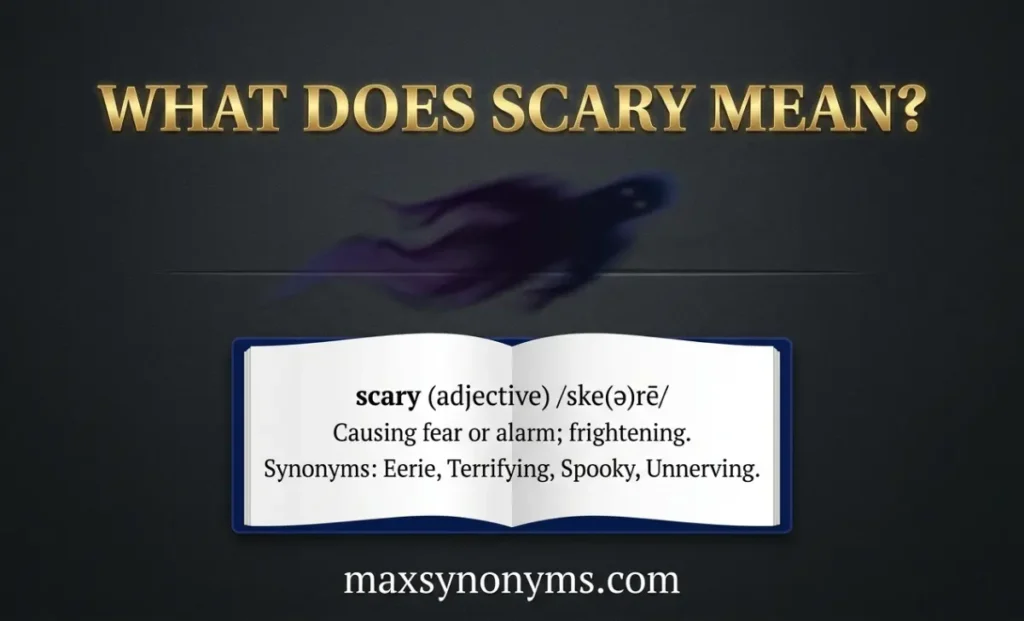
Scary is an adjective that describes something that causes fear, makes someone feel uneasy, or seems likely to be dangerous. It can describe a person, place, experience, sound, movie, or situation.
For example, a sudden noise in a dark room might be scary because you do not know what caused it. Similarly, a frightening experience can leave someone feeling nervous even after the danger has passed.
The word is common in everyday English and works in both casual conversation and general writing.
Examples:
- The movie was scary, but I enjoyed the ending.
- Walking through the empty building felt scary.
- He told us a scary story before bed.
Best Synonyms for Scary
Not every alternative expresses the same level of fear. Some words describe ordinary fright, while others suggest intense terror or an uncomfortable feeling.
Here are some of the most useful choices.
| Word | Meaning | Example |
|---|---|---|
| Frightening | Causing fear | The storm was frightening. |
| Terrifying | Causing extreme fear | It was a terrifying experience. |
| Creepy | Making someone feel uneasy | That empty house looks creepy. |
| Spooky | Strange and slightly frightening | We walked past a spooky old cemetery. |
| Horrifying | Causing intense fear or shock | They witnessed a horrifying scene. |
| Chilling | Creating a strong feeling of fear | She shared a chilling story. |
| Eerie | Strange, mysterious, and unsettling | An eerie silence filled the room. |
| Alarming | Causing concern or fear | The sudden change was alarming. |
| Unnerving | Making someone feel nervous | His unexplained behavior was unnerving. |
| Menacing | Suggesting danger or harm | A menacing figure stood near the gate. |
| Ominous | Suggesting that something bad may happen | The dark clouds looked ominous. |
| Intimidating | Making someone feel nervous or less confident | The huge building looked intimidating. |
Quick tip: Use frightening as a general alternative, terrifying for intense fear, and creepy when something makes you uncomfortable without necessarily presenting an obvious danger.
Extremely Scary Synonyms
Sometimes, ordinary words do not communicate how intense an experience feels. In those cases, a stronger alternative can make your writing more precise.
Consider these words when describing extreme fear:
- Petrifying: So frightening that someone feels almost unable to react.
- Bone-chilling: Creating an intense feeling of fear or dread.
- Bloodcurdling: Extremely frightening, often describing a scream or sound.
- Hair-raising: Causing intense fear or excitement.
- Horrific: Extremely shocking, unpleasant, or frightening.
- Nightmarish: Resembling a nightmare or an intensely disturbing experience.
- Fearsome: Inspiring fear, often because of strength or power.
For example, “The noise was scary” gives a general impression. However, “A bloodcurdling scream echoed through the hallway” creates a much stronger image.
Use powerful words when the situation justifies them. Otherwise, they can make an ordinary event sound more dramatic than it really is.
Scary Synonyms in Slang and Gen Z English
In casual conversations, people often use informal expressions instead of more traditional vocabulary. These choices can make dialogue sound natural, especially in texts, social media posts, and conversations with friends.
| Slang or Expression | Meaning | Example |
|---|---|---|
| Freaky | Strange, unsettling, or frightening | That was a freaky experience. |
| Spooky | Mysterious or frightening | This place is spooky at night. |
| Creepy | Uncomfortably strange | That message was creepy. |
| Sketchy | Seeming suspicious or potentially unsafe | That alley looks sketchy. |
| Gives me the creeps | Makes someone feel uneasy or afraid | That old doll gives me the creeps. |
| Nightmare fuel | Something so disturbing that it may cause nightmares | That picture is pure nightmare fuel. |
What Does Creepy Mean in Gen Z Slang?
In Gen Z conversations, creepy usually describes someone or something that feels unsettling, uncomfortable, or suspicious. It can refer to a person’s behavior, an unusual message, a strange image, or an uncomfortable situation.
For example, “He kept watching me without saying anything. It was creepy.”
The word does not always mean that something is dangerous. It often describes the uncomfortable feeling that something is not quite right.
Remember that slang depends on context. Sketchy, for instance, usually suggests suspicion or possible risk rather than fear alone.
Synonyms for Scary-Looking Things and People
A person, building, animal, or object may look scary without actually doing anything frightening. In this context, words that describe appearance or the impression something creates are often more useful.
| Word | Best Use | Example |
|---|---|---|
| Fearsome | Someone or something that inspires fear | The fearsome creature guarded the cave. |
| Menacing | An appearance that suggests danger | He gave us a menacing look. |
| Intimidating | An appearance that makes others nervous | The security guard looked intimidating. |
| Grotesque | An appearance that seems distorted or unpleasant | The mask had a grotesque face. |
| Forbidding | A place or appearance that seems unwelcoming | The castle had a forbidding entrance. |
| Sinister | Something that suggests evil or harmful intentions | A sinister smile crossed his face. |
| Eerie | An appearance that feels strange or mysterious | An eerie shadow moved across the wall. |
What Is a Scary Person Called?
A scary person can be described as intimidating, menacing, fearsome, or sinister, depending on the situation.
For example, an intimidating person may make others nervous because of their size, confidence, or behavior. A menacing person appears to threaten harm, while a sinister person seems to have evil or harmful intentions.
You can also use a frightening figure for a person whose appearance or presence causes fear. In casual conversation, people may simply say that someone is creepy.
Choose the description carefully because these words suggest different things about the person.
What Is a Fancy or Professional Word for Scary?
In formal writing, a precise word often works better than simply replacing scary with a more complicated alternative.
- Disturbing: Suitable for something that causes emotional discomfort or concern.
- Alarming: Useful when something creates serious concern.
- Ominous: Appropriate when signs suggest a possible future problem.
- Unsettling: A measured way to describe discomfort or unease.
- Intimidating: Useful when someone or something creates nervousness or pressure.
- Appalling: Appropriate for something extremely shocking or unacceptable.
For example, “The report revealed an alarming increase in complaints” sounds more precise than “The report revealed a scary increase in complaints.”
In professional writing, choose the word that explains the actual problem. A formal alternative should improve clarity, not merely make the sentence sound more impressive.
Words for Something Scary but Beautiful
Sometimes, something can be frightening and beautiful at the same time. A mist-covered forest, a ruined castle, or a dark cinematic scene might create this unusual combination.
These words can help express that feeling:
- Haunting: Beautiful, memorable, or emotionally powerful in a way that lingers.
- Eerie: Strange and mysterious, sometimes with an unusual beauty.
- Otherworldly: Seeming to belong to another world.
- Macabre: Associated with death or disturbing subjects, sometimes in an artistic style.
- Gothic: Evoking dark beauty, mystery, old buildings, or horror-related themes.
For example, “The abandoned castle had a haunting beauty” describes something attractive that also feels sad or unsettling.
Similarly, “The landscape looked eerie but beautiful under the moonlight” communicates both feelings without forcing them into a single word.
Hauntingly beautiful is especially useful when something is attractive yet emotionally unsettling.
Synonyms for Scary That Start With O
If you need an alternative beginning with the letter O, ominous is one of the most useful choices. However, it does not mean exactly the same thing as scary.
- Ominous: Suggests that something bad may happen.
- Oppressive: Describes an atmosphere or feeling that seems heavy, suffocating, or difficult to endure.
- Otherworldly: Suggests something strange, supernatural, or unlike the ordinary world.
Examples:
- The ominous silence made everyone nervous.
- An oppressive darkness covered the narrow passage.
- An otherworldly figure appeared through the fog.
Use ominous when you want to suggest danger or a bad outcome, rather than simply describing something that causes fear.
Antonyms of Scary
The opposite of scary depends on what makes something frightening. If it creates fear, its opposite may feel comforting or reassuring. If it seems dangerous, the opposite may be safe or harmless.
| Antonym | Meaning | Example |
|---|---|---|
| Comforting | Making someone feel better or less worried | Her comforting words helped me relax. |
| Reassuring | Restoring confidence or reducing fear | The doctor’s explanation was reassuring. |
| Soothing | Helping someone feel calm | The soothing music eased my anxiety. |
| Pleasant | Giving enjoyment or a positive feeling | We had a pleasant evening. |
| Harmless | Not causing harm or danger | The strange-looking insect was harmless. |
| Safe | Protected from danger | The children were safe inside. |
| Peaceful | Calm and free from disturbance | The peaceful garden helped me relax. |
These words are contextual opposites rather than perfect antonyms in every sentence. For example, harmless describes a lack of danger, while pleasant describes a positive experience.
Example Sentences Using Scary Synonyms
Seeing alternatives in complete sentences makes it easier to understand how they work in everyday English.
Daily conversation
- That noise was frightening, so I checked the front door.
- The old basement feels creepy after dark.
- The roller coaster was terrifying, but I would ride it again.
Creative writing
- An eerie mist drifted between the trees.
- A menacing shadow appeared behind the curtain.
- The character heard a bloodcurdling scream from upstairs.
Formal writing
- The sudden rise in reported incidents was alarming.
- The evidence revealed a disturbing pattern.
- The warning signs created an ominous atmosphere.
Each alternative adds a slightly different meaning. Therefore, consider whether you want to express fear, danger, mystery, discomfort, or shock.
Scary vs. Creepy vs. Spooky vs. Terrifying
These four words are related, but their meanings are not identical.
| Word | Main Meaning | Best Use |
|---|---|---|
| Scary | Causing fear | General situations |
| Creepy | Creating discomfort or unease | Strange behavior or unsettling places |
| Spooky | Strange, mysterious, or mildly frightening | Ghost stories and unusual settings |
| Terrifying | Causing extreme fear | Intense or dangerous experiences |
For example, a Halloween decoration may look spooky, while an unfamiliar person following you may seem creepy. A horror movie can be scary, whereas a genuinely life-threatening experience may be terrifying.
Easy rule: Use scary for general fear, creepy for discomfort, spooky for mysterious or ghostly feelings, and terrifying for extreme fear.
How to Choose the Best Alternative
The most effective word depends on what you are describing and the feeling you want readers to understand.
- For a horror story: Try eerie, chilling, sinister, or terrifying.
- For a scary person: Consider intimidating, menacing, or fearsome.
- For professional writing: Choose disturbing, alarming, or unsettling.
- For casual conversation: Use creepy, freaky, or spooky.
- For something scary and beautiful: Consider haunting or otherworldly.
Avoid choosing an unfamiliar word simply because it sounds impressive. The clearest and most accurate alternative usually makes the strongest impression.
Frequently Asked Questions
What are 10 synonyms for scary?
Ten useful alternatives are frightening, terrifying, creepy, spooky, horrifying, chilling, eerie, alarming, unnerving, and menacing. Each has a slightly different meaning, so choose one that fits the situation.
What is a big word for scary?
Petrifying is a strong alternative that describes something extremely frightening. Horrific and terrifying are also powerful choices, depending on the context.
Are scared and scary synonyms?
No. Scary describes something that causes fear, while scared describes the feeling experienced by a person or animal. For example, “The movie is scary” and “I am scared of the movie.”
What is another word for fear?
Depending on the context, alternatives include fright, terror, dread, anxiety, and apprehension. Terror suggests intense fear, while apprehension often means worry about something that may happen.
What is a slang word for scary?
Freaky, creepy, and spooky are common informal choices. The expression “gives me the creeps” is another natural way to say that something makes you uncomfortable or afraid.
How do you say very scary?
You can use terrifying, petrifying, bone-chilling, or horrifying. For example, “The experience was absolutely terrifying.”
What is a fancy word for creepy?
Eerie is a useful alternative when something feels strange or mysterious. Unnerving works when something makes you uncomfortable, while sinister suggests evil or harmful intentions.
How do you say creepy professionally?
Use unsettling, disturbing, or concerning, depending on the meaning. For example, “The behavior was unsettling” sounds more measured than “The behavior was creepy.”
Conclusion
The best alternative to scary depends on the feeling you want to describe. Use frightening for general fear, terrifying for extreme fear, creepy for discomfort, and spooky for mysterious or ghostly situations.
Words such as ominous, menacing, and haunting add more specific meaning when the context calls for them.
Instead of choosing the strongest word every time, focus on accuracy. A well-chosen synonym helps readers picture the situation and understand exactly how it feels.
Read More Blogs:
- Unless Otherwise Specified: Meaning, Usage, and Examples
- Respect Synonyms: 50 Better Words with Meanings and Examples
- Opportunity Synonyms: Natural Alternatives for Work and Life

I am Ali Hamza, a writer and language lover with four years of experience creating content about synonyms, vocabulary and English word usage. I like making words and meanings easier to understand through clear explanations and real-life examples.
As the author of maxsynonyms.com I focus on helping readers find synonyms improve their vocabulary and pick the right words for different situations. My goal is to provide easy-to-read content that helps students, writers, professionals and English learners.
Through maxsynonyms.com I am dedicated to sharing quality language tools that make learning English simple, interesting and available, to all.