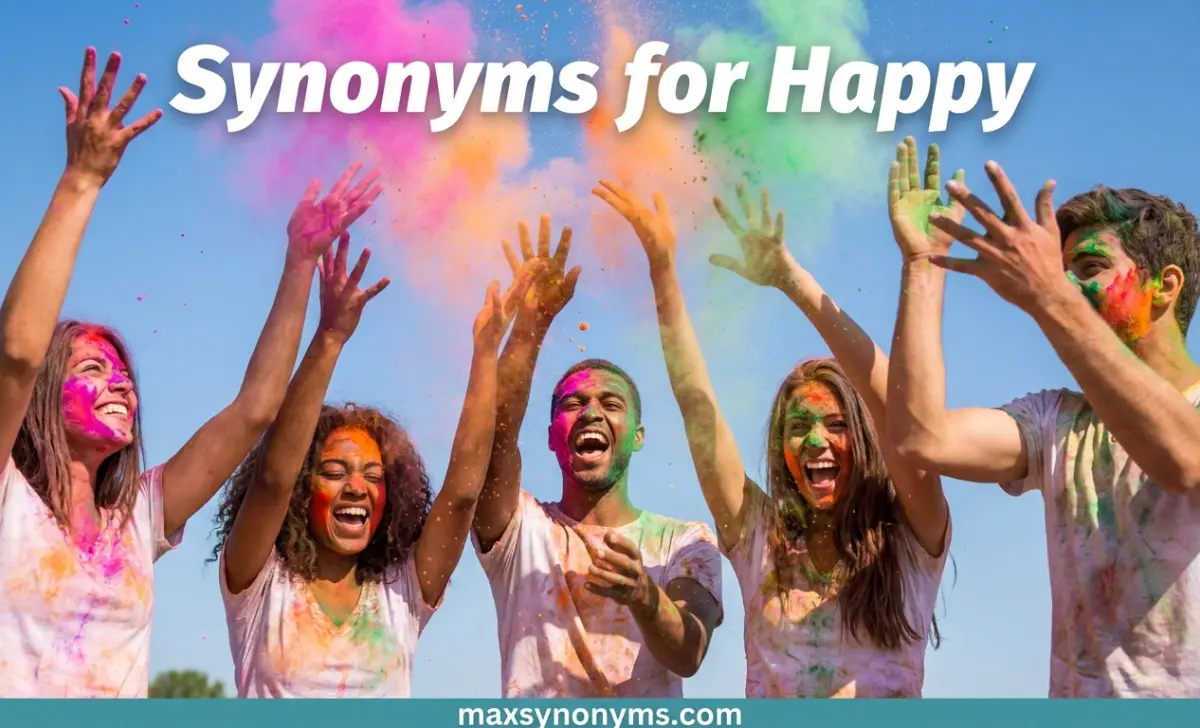
Happiness can feel calm, exciting, or almost impossible to describe. Sometimes, happy is the perfect word.
Other times, a word like delighted, content, thrilled, or overjoyed expresses your feelings more clearly.
The best synonym depends on the situation. This guide covers everyday alternatives, fancy vocabulary, slang, antonyms, and practical examples to help you express happiness naturally.
What Does Happy Mean?
Happy is an adjective that describes a feeling of pleasure, joy, or satisfaction. It can describe a temporary emotion, a positive experience, or someone’s general mood.
For example:
- I am happy with the results of my exam.
- She felt happy when her family visited.
- He is usually cheerful and happy around his friends.
Happiness does not always mean excitement. Someone can feel happy and peaceful after a relaxing evening, while another person may feel thrilled after receiving great news.
Understanding this difference helps you choose a more precise word.
What Are the Best Synonyms for Happy?
Here are some of the most useful synonyms for happy, with their meanings and examples.
| Synonym | Meaning | Example |
|---|---|---|
| Joyful | Full of joy | The children were joyful during the celebration. |
| Cheerful | Showing a positive mood | She greeted everyone with a cheerful smile. |
| Glad | Pleased about something | I am glad you came to visit. |
| Delighted | Very pleased | He was delighted with his birthday gift. |
| Pleased | Feeling satisfaction | The teacher was pleased with her progress. |
| Content | Happy with what you have | She felt content sitting in her garden. |
| Satisfied | Pleased with a result or experience | I am satisfied with the final design. |
| Thrilled | Extremely excited and happy | They were thrilled to hear the good news. |
| Elated | Feeling intense happiness | He felt elated after winning the competition. |
| Ecstatic | Overwhelmingly happy | She was ecstatic when she received the offer. |
| Blissful | Extremely happy and peaceful | They enjoyed a blissful afternoon together. |
| Jubilant | Showing great joy, often after success | The fans were jubilant after the victory. |
| Gleeful | Showing lively delight | The children gave gleeful laughs. |
| Merry | Cheerful and festive | Everyone enjoyed a merry holiday gathering. |
| Upbeat | Positive and optimistic | Her upbeat attitude encouraged the team. |
| Fulfilled | Feeling that something meaningful has been achieved | He felt fulfilled after helping his community. |
| Grateful | Appreciative of something good | She felt grateful for her friends’ support. |
| Lighthearted | Free from worry or seriousness | They had a lighthearted conversation over lunch. |
| Overjoyed | Filled with great joy | The parents were overjoyed at the news. |
| Exuberant | Full of energy and excitement | The exuberant crowd welcomed the performers. |
These words are related, but they are not interchangeable in every sentence. Content suggests quiet satisfaction, thrilled expresses excitement, and grateful focuses on appreciation.
What Are 10 Synonyms for Happiness?
Happy is an adjective, while happiness is a noun. If you want words that describe the feeling or state of being happy, these ten are useful:
- Joy — a feeling of great happiness.
- Delight — strong pleasure or enjoyment.
- Cheerfulness — a positive, lively mood.
- Contentment — satisfaction with your circumstances.
- Bliss — complete or intense happiness.
- Elation — a feeling of excitement and great joy.
- Euphoria — an intense feeling of well-being or excitement.
- Jubilation — great happiness, often after a success.
- Merriment — cheerful enjoyment and laughter.
- Pleasure — enjoyment or satisfaction.
For example, “Her happiness was clear” could become “Her joy was clear.” In another context, “He found happiness in a simple life” might be rewritten as “He found contentment in a simple life.”
The best choice depends on the kind of happiness you want to describe.
What Are 30 Synonyms for Happy?
If you need a broad vocabulary list for writing, schoolwork, or everyday communication, start with these 30 alternatives.
- Joyful
- Cheerful
- Glad
- Delighted
- Pleased
- Content
- Satisfied
- Thrilled
- Elated
- Ecstatic
- Blissful
- Jubilant
- Gleeful
- Merry
- Jolly
- Upbeat
- Fulfilled
- Grateful
- Lighthearted
- Overjoyed
- Exuberant
- Exhilarated
- Buoyant
- Jovial
- Mirthful
- Radiant
- Sunny
- Carefree
- Optimistic
- Rapturous
Some words describe an emotion, while others describe a person’s mood or attitude. For instance, jovial often describes someone who is cheerful and sociable. Optimistic means expecting good things to happen, which is not exactly the same as feeling happy.
Use the word that fits the meaning you want to communicate.
What Is the Fancy Word for Happy?

If you want a more sophisticated alternative to happy, consider these words:
- Euphoric: Feeling intense happiness or well-being.
- Exultant: Showing great joy, often after a victory.
- Ebullient: Full of enthusiasm and lively energy.
- Jubilant: Extremely happy, especially after success.
- Rapturous: Showing overwhelming delight.
- Beatific: Showing a peaceful, almost heavenly happiness.
- Exuberant: Expressing joy through energy and excitement.
- Blissful: Experiencing deep happiness or peace.
- Elated: Feeling great happiness and excitement.
- Mirthful: Full of amusement and laughter.
For example, instead of writing “She was very happy about the achievement,” you could say, “She was elated by the achievement.”
Fancy vocabulary can make writing more expressive, but it should still sound natural. Euphoric may suit an extraordinary success, while content is better for quiet satisfaction.
What Is Another Word for Extremely Happy?
When ordinary happiness is not enough to describe a feeling, these words can express greater intensity:
- She was ecstatic when she learned she had been accepted into college.
- He felt overjoyed when his family returned home.
- We were thrilled to see our favorite performers.
- The team was jubilant after winning the final.
- Ecstatic: Overwhelmingly happy.
- Overjoyed: Filled with intense joy.
- Elated: Extremely pleased and excited.
- Euphoric: Experiencing intense happiness or well-being.
- Thrilled: Very excited and pleased.
- Exultant: Showing great joy after a success.
- Jubilant: Celebrating a happy outcome.
- Rapturous: Expressing overwhelming delight.
- Enraptured: Completely absorbed in delight or pleasure.
- On cloud nine: An informal expression for feeling extremely happy.
Examples:
Use ecstatic or euphoric for intense feelings. Choose thrilled when excitement is part of the emotion, and content when the happiness is quieter.
How Do You Say Happy in a Unique Way?
You can express happiness more memorably by choosing a specific word or phrase instead of repeating happy.
| Expression | Best use | Example |
|---|---|---|
| Over the moon | Very pleased about good news | I’m over the moon about my new job. |
| On cloud nine | Extremely happy | She has been on cloud nine since graduation. |
| Walking on air | Feeling light with happiness | He was walking on air after their first date. |
| Tickled pink | Very pleased or amused | Grandma was tickled pink by the surprise. |
| In high spirits | Cheerful and energetic | The team was in high spirits after the event. |
| Bursting with joy | Feeling intense happiness | She was bursting with joy when she saw the puppy. |
| Beaming | Showing happiness through a bright smile | He was beaming after hearing the news. |
| On top of the world | Feeling exceptionally happy or successful | I felt on top of the world after finishing the race. |
You can also make a sentence more personal. Instead of saying “I am happy for you,” try “Your success genuinely makes me smile.”
The aim is not to sound complicated. It is to express the feeling in a way that suits the moment.
What Can I Say Instead of “I’m Happy”?
The best replacement depends on why you feel happy.
- Instead of “I’m happy you called,” say, “I’m glad you called.”
- Instead of “I’m happy about my promotion,” say, “I’m thrilled about my promotion.”
- Instead of “I’m happy with the results,” say, “I’m pleased with the results.”
- Instead of “I’m happy for you,” say, “I’m genuinely delighted for you.”
- I’m glad: A natural response to good news.
- I’m delighted: A slightly more formal expression of pleasure.
- I’m thrilled: Useful when you feel excited.
- I’m pleased: Suitable for professional or polite situations.
- I’m overjoyed: Expresses intense happiness.
- I’m grateful: Focuses on appreciation.
- I’m feeling great: Casual and conversational.
- I’m in a good mood: Describes your current emotional state.
- I couldn’t be happier: Emphasizes very strong satisfaction.
- This means so much to me: Expresses emotional significance.
examples:
Choose a phrase that reflects your real feeling rather than simply replacing one word with another.
Synonyms for Happy in Different Situations
A synonym can sound natural in one situation but awkward in another. These examples show how to choose the right word.
Happy at work
Use pleased, satisfied, fulfilled, or elated, depending on the context.
- I’m pleased with the team’s progress.
- She felt fulfilled by the work she was doing.
- He was elated after receiving the promotion.
Happy in relationships
Use joyful, delighted, grateful, or overjoyed.
- I was delighted to see my old friend.
- She felt grateful for her partner’s support.
- They were overjoyed to welcome their new baby.
Happy after an achievement
Use thrilled, elated, jubilant, or exultant.
- He was thrilled to pass his final exam.
- The players were jubilant after the win.
- She felt elated after completing her first marathon.
Happy and peaceful
Use content, contented, blissful, or at ease.
- He felt content with his simple routine.
- They spent a blissful afternoon by the lake.
- She felt at ease after resolving the disagreement.
Happy and optimistic
Use upbeat, cheerful, sunny, or buoyant.
- Her upbeat attitude helped the team stay motivated.
- He remained cheerful during a difficult week.
- The encouraging news left everyone feeling buoyant.
Synonyms for Happy for Kids
Children often benefit from simple words and clear examples. These alternatives are useful for school assignments and everyday conversations.
- Glad: Happy about something.
- Joyful: Full of joy.
- Cheerful: Showing a happy mood.
- Pleased: Feeling good about something.
- Excited: Feeling eager and happy about something coming up.
- Delighted: Very pleased.
- Jolly: Cheerful and full of fun.
- Thrilled: Very excited and happy.
- Content: Happy with what you have.
- Grateful: Feeling thankful for something good.
Examples:
- I am glad my friend came to play.
- The children were excited about the school trip.
- She was delighted to receive a new book.
- He felt grateful when his sister helped him.
A useful lesson for young learners is that emotions can overlap without being identical. Excited often includes anticipation, while content describes satisfaction.
What Are 10 Antonyms of Happy?
Antonyms are words with opposite or contrasting meanings. Here are ten common antonyms of happy.
| Antonym | Meaning | Example |
|---|---|---|
| Sad | Feeling sorrow | He felt sad when his friend moved away. |
| Unhappy | Not feeling happy | She was unhappy with the decision. |
| Miserable | Extremely unhappy or uncomfortable | He felt miserable after the disappointing news. |
| Gloomy | Dark or low in mood | The gloomy weather matched his mood. |
| Glum | Quietly sad or disappointed | She looked glum after the cancellation. |
| Sorrowful | Full of sadness | They were sorrowful after the loss. |
| Dejected | Feeling low after a setback | He felt dejected after missing the opportunity. |
| Downcast | Looking or feeling sad | The players looked downcast after the defeat. |
| Discontented | Not satisfied with a situation | She felt discontented with her current role. |
| Miserable | Very unhappy or distressed | The long delay left everyone miserable. |
Miserable appears twice in the table above because it is a common opposite, but a more varied ten-word list would replace the second instance with despondent, meaning deeply discouraged or unhappy.
Not every antonym fits every sentence. Discontented usually means dissatisfied, while sorrowful specifically expresses sadness. Choose the word that matches the emotion.
Happy vs. Joyful vs. Cheerful vs. Content
These words are closely related, but each has a different emphasis.
Happy is the broadest term. It works for many positive feelings and situations.
Joyful suggests a strong or noticeable feeling of joy. It often suits celebrations and meaningful moments.
Cheerful describes a positive mood or the way someone behaves. A cheerful person may smile and speak warmly.
Content describes quiet satisfaction. Someone can feel content without being excited or energetic.
Compare these examples:
- She was happy about her new home.
- She felt joyful when her family arrived.
- The cheerful receptionist welcomed every visitor.
- He felt content with his peaceful life.
Use happy when you want a simple, flexible word. Choose a more specific alternative when it adds a useful distinction.
Synonyms for “Happy for You,” “Happy to Help,” and “Happy Birthday”
Some phrases have a particular meaning, so replacing happy requires care.
Another way to say “I’m happy for you”
- I’m delighted for you.
- I’m thrilled for you.
- I’m so glad things worked out for you.
- Your success makes me genuinely happy.
- I’m excited to see you achieve this.
Example: “I’m thrilled for you—you worked so hard for this opportunity.”
Another way to say “I’m happy to help”
- I’m glad to help.
- I’d be pleased to help.
- I’m happy to lend a hand.
- I’d be glad to assist.
- It’s my pleasure to help.
Example: “I’d be pleased to help you prepare for the interview.”
Here, happy to help expresses willingness as well as a positive attitude. Ecstatic to help would usually sound exaggerated.
Another way to say “Happy Birthday”
Birthday greetings are fixed expressions, so a normal synonym does not always fit. You can make the message more personal with phrases such as:
- Wishing you a wonderful birthday!
- Hope your day is full of joy.
- Wishing you a fantastic year ahead.
- May your birthday bring you plenty of happiness.
- Hope your special day is filled with laughter and love.
These are alternative greetings, not exact synonyms for the phrase Happy Birthday.
What Are 100 Happy Words That Describe Happiness?
If you’re looking for a large vocabulary list, the following words and expressions cover joy, satisfaction, excitement, optimism, and positive moods. Some are direct synonyms; others describe related feelings or ways of expressing happiness.
Common words: Happy, glad, joyful, cheerful, pleased, delighted, content, contented, satisfied, merry, jolly, gleeful, blissful, thrilled, elated, ecstatic, jubilant, overjoyed, exuberant, exhilarated.
Positive moods and attitudes: Upbeat, optimistic, sunny, buoyant, lighthearted, carefree, jovial, genial, warm, friendly, hopeful, positive, enthusiastic, lively, spirited, energetic, playful, animated, smiling, beaming.
Deeper happiness and satisfaction: Fulfilled, grateful, appreciative, peaceful, serene, tranquil, at ease, comfortable, fortunate, blessed, encouraged, reassured, inspired, refreshed, relaxed, secure, harmonious, pleased with life, satisfied with life, at peace.
Strong joy and excitement: Euphoric, exultant, rapturous, enraptured, ecstatic, triumphant, celebratory, exuberant, radiant, effervescent, ebullient, vivacious, sparkling, elated, delighted, over the moon, on cloud nine, walking on air, on top of the world, bursting with joy.
Cheerful and expressive words: Mirthful, merryhearted, jocund, blithe, sunny-natured, good-humored, high-spirited, laughter-filled, smiling, joyful-hearted, upbeat, cheerful, jolly, gleeful, playful, lively, animated, bubbly, bright-eyed, warmhearted.
Some items in this list are phrases rather than single words, and a few describe related qualities instead of happiness itself.
For instance, hopeful means expecting a positive outcome, while grateful means appreciating something. They can accompany happiness, but they do not always mean the same thing.
Common Mistakes When Choosing Happy Synonyms
1. Using every synonym as an exact replacement
Ecstatic is much stronger than pleased. Content suggests calm satisfaction, not intense excitement.
2. Confusing happiness with excitement
You can be excited about a future event without feeling happy in every respect. Use eager or enthusiastic when anticipation is the main idea.
3. Confusing gratitude with happiness
Grateful means thankful. You might feel grateful and happy at the same time, but the words express different ideas.
4. Choosing fancy words that sound unnatural
Words such as ebullient and rapturous can work in expressive writing, but they may sound overly formal in a casual message.
5. Repeating “very happy” too often
Instead of adding very every time, choose a more precise word. For example, use thrilled for excitement or content for quiet satisfaction.
Frequently Asked Questions About Happy Synonyms
What is another word for happy?
Common alternatives include glad, joyful, cheerful, pleased, delighted, and content. The best choice depends on the sentence.
What are ten synonyms for happiness?
Ten useful nouns are joy, delight, cheerfulness, contentment, bliss, elation, euphoria, jubilation, merriment, and pleasure.
What is the fanciest word for happy?
There is no single best fancy word. Ebullient, euphoric, exultant, and rapturous are sophisticated options, each with a different meaning.
What are five strong synonyms for happy?
Delighted, thrilled, elated, ecstatic, and overjoyed express strong happiness.
What is another word for happily?
Depending on the sentence, you can use joyfully, cheerfully, gladly, merrily, or contentedly. These are adverbs, so they describe how an action is performed.
What is a unique way to say happy?
Try over the moon, on cloud nine, walking on air, or bursting with joy. These expressions add personality to everyday writing.
What is the difference between happy and satisfied?
Happy describes a broad positive feeling. Satisfied usually means that a need, expectation, or goal has been met.
Is excited a synonym for happy?
Sometimes. Excited describes strong interest or anticipation and can include happiness, but it is not a perfect replacement in every context.
What are ten antonyms of happy?
Common antonyms include sad, unhappy, miserable, gloomy, glum, sorrowful, dejected, downcast, discontented, and despondent.
What are some simple happy words for kids?
Glad, joyful, cheerful, pleased, excited, delighted, jolly, thrilled, content, and grateful are useful choices for young learners.
Conclusion
The best synonym for happy depends on the feeling you want to express.
Choose joyful for joy, cheerful for a positive mood, content for quiet satisfaction, or ecstatic for intense happiness.
Specific words and natural examples will make your writing clearer and more expressive.
Read More Blogs:
- Similar Synonyms: Meaning, Examples, and Better Alternatives
- Let’s Keep in Touch: Meaning, Alternatives, and How to Reply
- However Synonyms: Better Words for Clearer Writing

I am Ali Hamza, a writer and language lover with four years of experience creating content about synonyms, vocabulary and English word usage. I like making words and meanings easier to understand through clear explanations and real-life examples.
As the author of maxsynonyms.com I focus on helping readers find synonyms improve their vocabulary and pick the right words for different situations. My goal is to provide easy-to-read content that helps students, writers, professionals and English learners.
Through maxsynonyms.com I am dedicated to sharing quality language tools that make learning English simple, interesting and available, to all.