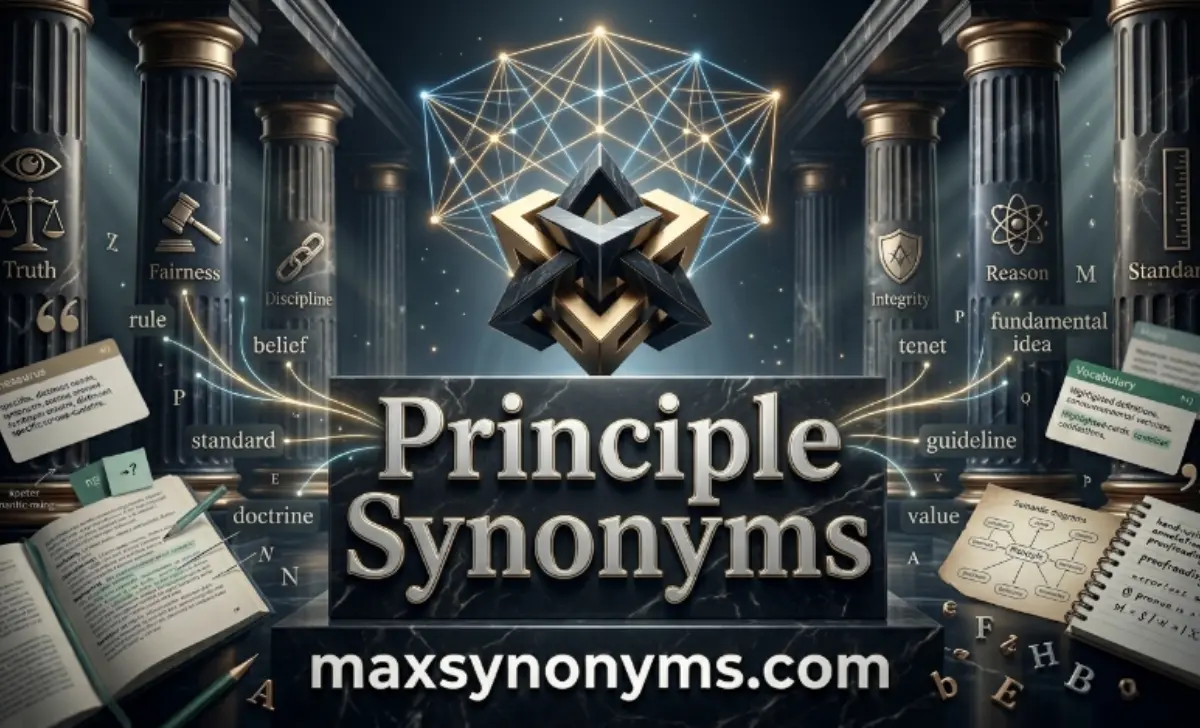
Have you ever used the word principle several times in the same essay, email, or article? Finding the right alternative can make your writing sound clearer and more natural. However, not every word that is related to a principle is a true synonym.
The word principle can mean a basic rule, a strong belief, or a basic idea behind something. For example, “Honesty is one of my principles” means honesty is a belief that guides my actions.
In science or mathematics, it can describe a basic rule that explains how something works. This guide covers synonyms for principle that fit different contexts, from everyday rules and beliefs to academic ideas.
Students, bloggers, content writers, and daily English users can use these alternatives to avoid repetition and choose more precise words.
Table of Contents
- Quick Answer
- True Synonyms and Close Alternatives
- Rule
- Belief
- Value
- Guideline
- Standard
- Ethic
- Tenet
- Precept
- Doctrine
- Maxim
- Axiom
- Postulate
- Foundation
- Basis
- Concept
- Idea
- Proposition
- Policy
- Code
- Criterion
- Convention
- Practice
- Philosophy
- Motto
- Ideal
- Moral
- Law
- Theory
- Premise
- Assumption
- Rule of Thumb
- Framework
- Approach
- Method
- Policy Guideline
- Code of Conduct
- Operating Rule
- Guiding Belief
- Guiding Idea
- Core Value
- Basic Rule
- Fundamental Idea
- Related Concepts
- Justice
- Honesty
- Fairness
- Integrity
- Responsibility
- Duty
- Virtue
- Morality
- Commitment
- Principle in Different Contexts
- FAQs
Quick Answer
The best synonyms for principle depend on the meaning. For a rule, use rule, guideline, standard, precept, or regulation. For a belief, use belief, value, ethic, tenet, or ideal. For a basic idea, use concept, basis, foundation, axiom, or premise.
Some words are only related to principle, rather than direct synonyms. Words such as justice, honesty, fairness, integrity, and duty describe values or moral ideas that can be principles, but they do not always replace the word principle.
True Synonyms and Close Alternatives
The following words are the strongest choices when you want to replace principle. The exact choice still depends on the sentence and meaning.
Rule
Part of speech: Noun
Meaning: A rule is something that tells people what they should or should not do.
Examples:
- Always follow the school rule.
- This rule keeps everyone safe.
Belief
Part of speech: Noun
Meaning: A belief is an idea that someone accepts as true or important.
Examples:
- Kindness is an important belief in her family.
- His belief in fairness guides his choices.
Value
Part of speech: Noun
Meaning: A value is an idea about what is good, right, or important.
Examples:
- Respect is an important family value.
- The company promotes strong values.
Guideline
Part of speech: Noun
Meaning: A guideline is advice that helps people decide what to do.
Examples:
- Follow the writing guidelines.
- The guide gives clear guidelines for students.
Standard
Part of speech: Noun
Meaning: A standard is a level of quality or behavior that people are expected to meet.
Examples:
- The school has high standards.
- We must meet the safety standard.
Ethic
Part of speech: Noun
Meaning: An ethic is a belief about how people should behave.
Examples:
- Hard work is part of his work ethic.
- The team follows a strong professional ethic.
Tenet
Part of speech: Noun
Meaning: A tenet is a belief that a person or group considers important.
Examples:
- Trust is a key tenet of the organization.
- Equality is a central tenet of the group.
Precept
Part of speech: Noun
Meaning: A precept is a rule or belief that guides behavior.
Examples:
- Kindness is an important precept in her life.
- The teacher explained the basic precepts of the system.
Doctrine
Part of speech: Noun
Meaning: A doctrine is a set of beliefs accepted or taught by a group.
Examples:
- The group follows a clear doctrine.
- Students studied the doctrine in class.
Maxim
Part of speech: Noun
Meaning: A maxim is a short statement that gives a general rule or lesson.
Examples:
- “Practice makes perfect” is a common maxim.
- His favorite maxim is to treat people fairly.
Axiom
Part of speech: Noun
Meaning: An axiom is an idea accepted as true and used as a starting point.
Examples:
- The theory begins with a basic axiom.
- Students learned an important mathematical axiom.
Postulate
Part of speech: Noun
Meaning: A postulate is an idea accepted as true for reasoning or study.
Examples:
- The scientist started with a simple postulate.
- The geometry lesson introduced a new postulate.
Foundation
Part of speech: Noun
Meaning: A foundation is a basic idea or support on which something is built.
Examples:
- Trust is the foundation of their relationship.
- Grammar is the foundation of good writing.
Basis
Part of speech: Noun
Meaning: A basis is the main idea, reason, or support for something.
Examples:
- Trust is the basis of their agreement.
- The decision was based on clear facts.
Concept
Part of speech: Noun
Meaning: A concept is a basic idea about something.
Examples:
- The teacher explained the main concept.
- This concept is easy to understand.
Idea
Part of speech: Noun
Meaning: An idea is a thought, belief, or understanding.
Examples:
- The principle is based on a simple idea.
- She shared a useful idea with the class.
Proposition
Part of speech: Noun
Meaning: A proposition is an idea or statement that can be considered or tested.
Examples:
- The paper presents an interesting proposition.
- We discussed the main proposition in class.
Policy
Part of speech: Noun
Meaning: A policy is a plan or set of rules used by an organization.
Examples:
- The company has a clear privacy policy.
- Read the school policy before joining.
Code
Part of speech: Noun
Meaning: A code is a set of rules or beliefs that guides behavior.
Examples:
- The group follows a strict code.
- Doctors follow a professional code.
Criterion
Part of speech: Noun
Meaning: A criterion is a standard used to judge or decide something.
Examples:
- Price was the main criterion.
- Safety is an important criterion for this job.
Convention
Part of speech: Noun
Meaning: A convention is an accepted way of doing something.
Examples:
- This is a common writing convention.
- The design follows modern conventions.
Practice
Part of speech: Noun
Meaning: A practice is a usual way of doing something.
Examples:
- Recycling is a common practice here.
- Good writing practice takes time.
Philosophy
Part of speech: Noun
Meaning: A philosophy is a set of ideas that guides how someone thinks or acts.
Examples:
- Her philosophy is based on kindness.
- The company has a simple work philosophy.
Motto
Part of speech: Noun
Meaning: A motto is a short phrase that expresses a belief or goal.
Examples:
- “Never give up” is his motto.
- The school has a simple motto.
Ideal
Part of speech: Noun
Meaning: An ideal is a belief or standard that someone wants to achieve.
Examples:
- Equality is an important ideal.
- She believes strongly in this ideal.
Moral
Part of speech: Noun
Meaning: A moral is a lesson or belief about right and wrong.
Examples:
- The story has a clear moral.
- The moral of the tale is simple.
Law
Part of speech: Noun
Meaning: In science, a law is a basic statement that describes how something works.
Examples:
- The class studied a basic law of physics.
- The law explains how the system behaves.
Theory
Part of speech: Noun
Meaning: A theory is a set of ideas used to explain how or why something happens.
Examples:
- The theory explains the results.
- We studied the theory in science class.
Premise
Part of speech: Noun
Meaning: A premise is an idea or statement used as the basis for an argument.
Examples:
- The argument starts with a simple premise.
- His conclusion depends on that premise.
Assumption
Part of speech: Noun
Meaning: An assumption is something accepted as true without complete proof.
Examples:
- The plan is based on one assumption.
- We should test that assumption first.
Rule of Thumb
Part of speech: Noun phrase
Meaning: A rule of thumb is a simple rule based on experience.
Examples:
- As a rule of thumb, save some money each month.
- A useful rule of thumb is to check your work twice.
Framework
Part of speech: Noun
Meaning: A framework is a basic structure that helps organize ideas or actions.
Examples:
- The framework gives the project direction.
- Students used a simple framework for the essay.
Approach
Part of speech: Noun
Meaning: An approach is a particular way of dealing with a problem or situation.
Examples:
- We need a new approach to learning.
- Her approach is based on simple steps.
Method
Part of speech: Noun
Meaning: A method is a particular way of doing something.
Examples:
- This method works well for beginners.
- The teacher uses a simple method.
Policy Guideline
Part of speech: Noun phrase
Meaning: A policy guideline is advice that helps people follow an organization’s rules.
Examples:
- Read the policy guideline before applying.
- The new policy guideline is easy to follow.
Code of Conduct
Part of speech: Noun phrase
Meaning: A code of conduct is a set of rules about acceptable behavior.
Examples:
- Students must follow the code of conduct.
- The company updated its code of conduct.
Operating Rule
Part of speech: Noun phrase
Meaning: An operating rule is a basic rule used to guide how something works.
Examples:
- Safety is an important operating rule.
- The team follows a simple operating rule.
Guiding Belief
Part of speech: Noun phrase
Meaning: A guiding belief is an idea that helps someone make choices.
Examples:
- Honesty is her guiding belief.
- Service is a guiding belief for the team.
Guiding Idea
Part of speech: Noun phrase
Meaning: A guiding idea is a main thought that directs a plan or action.
Examples:
- Simplicity was the guiding idea behind the design.
- The project has one clear guiding idea.
Core Value
Part of speech: Noun phrase
Meaning: A core value is a belief that is very important to a person or group.
Examples:
- Respect is a core value of the school.
- Trust is one of our core values.
Basic Rule
Part of speech: Noun phrase
Meaning: A basic rule is a simple rule that guides behavior or action.
Examples:
- Follow this basic rule when using the machine.
- Honesty is a basic rule in their home.
Fundamental Idea
Part of speech: Noun phrase
Meaning: A fundamental idea is a basic thought that supports a subject or system.
Examples:
- Equality is a fundamental idea in the theory.
- The lesson starts with one fundamental idea.
Related Concepts
Not every word connected with principle can replace it in every sentence. The following terms are useful related concepts, especially when discussing moral values and behavior.
Justice
Part of speech: Noun
Meaning: Justice means treating people fairly and according to what is right.
Examples:
- Justice is important in every society.
- She believes strongly in justice.
Usage note: Justice can be a principle, but it is not a direct synonym for principle.
Honesty
Part of speech: Noun
Meaning: Honesty means telling the truth and avoiding lies.
Examples:
- Honesty is one of his main values.
- We should always practice honesty.
Usage note: Honesty can describe a personal principle, but it does not replace principle in every sentence.
Fairness
Part of speech: Noun
Meaning: Fairness means treating people equally and reasonably.
Examples:
- Fairness matters in every competition.
- The teacher was praised for her fairness.
Integrity
Part of speech: Noun
Meaning: Integrity means being honest and following strong moral values.
Examples:
- She is known for her integrity.
- Good leaders should show integrity.
Responsibility
Part of speech: Noun
Meaning: Responsibility means accepting a duty and doing what you should do.
Examples:
- Taking responsibility builds trust.
- He accepts responsibility for his work.
Duty
Part of speech: Noun
Meaning: Duty is something you are expected or required to do.
Examples:
- Helping others can be a moral duty.
- She takes her duty seriously.
Virtue
Part of speech: Noun
Meaning: A virtue is a good quality or moral behavior.
Examples:
- Honesty is a valuable virtue.
- Patience is often seen as a virtue.
Morality
Part of speech: Noun
Meaning: Morality is a system of ideas about right and wrong behavior.
Examples:
- The book explores questions of morality.
- His actions raised questions about morality.
Commitment
Part of speech: Noun
Meaning: Commitment is a strong promise or decision to support something.
Examples:
- His commitment to honesty is clear.
- The team showed commitment to its goal.
Principle in Different Contexts
The best synonym changes with the meaning of principle.
| Meaning of principle | Useful alternatives |
|---|---|
| A rule to follow | Rule, guideline, standard, precept |
| A personal belief | Belief, value, ethic, tenet |
| A moral idea | Moral, ethic, ideal, value |
| A basic idea | Concept, idea, basis, foundation |
| A scientific idea | Axiom, law, postulate, theory |
| An organization’s rules | Policy, code, guideline |
| A general lesson | Maxim, motto, precept |
For example, rule works well when talking about instructions. Value is better when talking about personal beliefs. Meanwhile, axiom or postulate fits academic or mathematical contexts better.
For authoritative dictionary definitions and usage information, you can also consult Merriam-Webster.
Internal Linking Suggestions
To build a stronger topic cluster, naturally link this article to related word guides on your site, such as:
- Synonyms for particular
- Synonyms for measure
- Synonyms for specific
- Synonyms for important
- Synonyms for rule
- Synonyms for idea
Use descriptive anchor text rather than generic phrases such as “click here.”
FAQs
What is the best synonym for principle?
The best synonym depends on the context. Rule, belief, value, guideline, standard, ethic, tenet, and concept are among the most useful choices.
What is a simple synonym for principle?
Rule is one of the simplest alternatives when principle means a rule that guides behavior. Belief or value may be better when it means a personal idea.
Is rule a synonym for principle?
Yes, in some contexts. When principle means a rule or guide for behavior, rule can be a close synonym. However, the two words are not interchangeable in every sentence.
What is a synonym for moral principle?
Useful alternatives include ethical belief, moral value, ethic, tenet, precept, and guiding belief.
What is a synonym for a basic principle?
Depending on the context, you can use basic idea, foundation, basis, fundamental idea, axiom, or postulate.
Are justice and honesty synonyms for principle?
No. Justice and honesty are related concepts rather than direct synonyms. They can be examples of principles or values, but they cannot replace principle in every sentence.
What is the difference between principle and principal?
Principle is usually a rule, belief, or basic idea. Principal can mean the person in charge of a school, or it can mean the most important person or thing. For example, “Honesty is a principle” is correct, while “The school principal spoke to us” uses the other word.
Conclusion
Learning different synonyms for principle gives you more control over your English. Words such as rule, belief, value, guideline, standard, tenet, precept, basis, and foundation can help you express the exact meaning you want.
Related words such as honesty, justice, integrity, and fairness can also help when discussing moral ideas, but they should not be treated as direct synonyms in every context.
Practice these words in essays, emails, blog posts, and daily conversations to make your writing clearer, stronger, and more natural.
Read More Blogs:
- Looking Forward to Speaking With You: Better Ways to Say It\
- Romance Synonyms: 50 Words for Love & Attraction

I am Ali Hamza, a writer and language lover with four years of experience creating content about synonyms, vocabulary and English word usage. I like making words and meanings easier to understand through clear explanations and real-life examples.
As the author of maxsynonyms.com I focus on helping readers find synonyms improve their vocabulary and pick the right words for different situations. My goal is to provide easy-to-read content that helps students, writers, professionals and English learners.
Through maxsynonyms.com I am dedicated to sharing quality language tools that make learning English simple, interesting and available, to all.