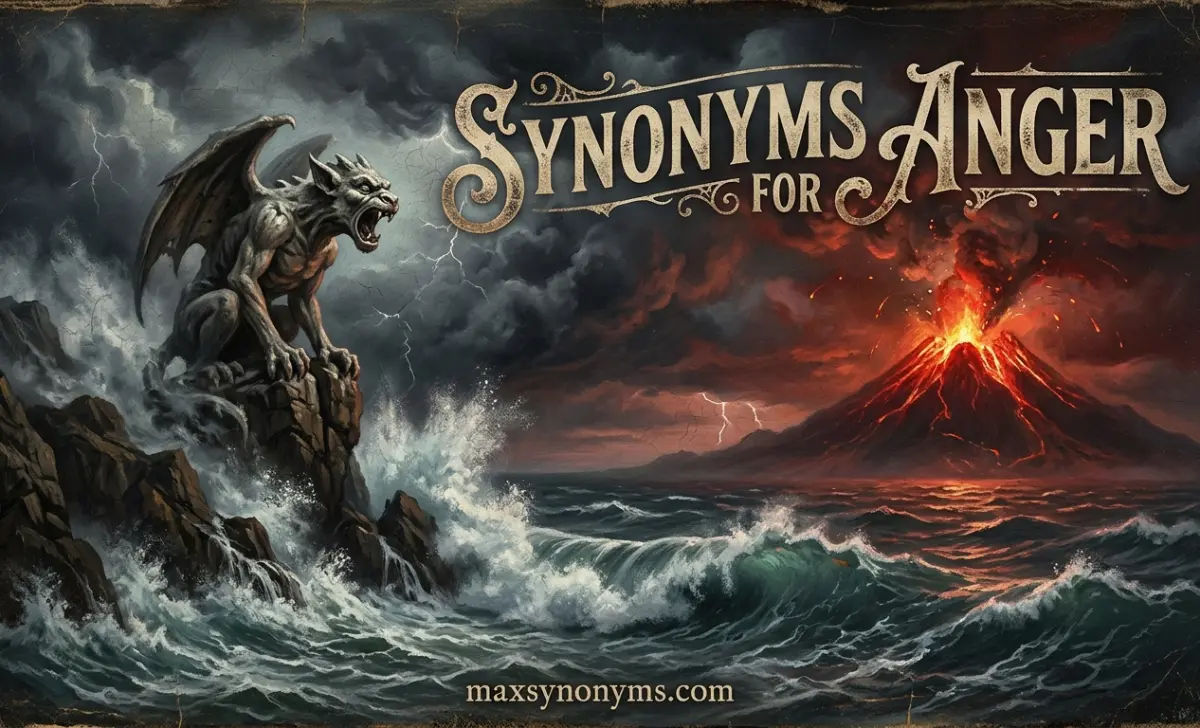
Anger is a natural emotion, but the word angry does not always express exactly how someone feels.
Sometimes you feel mildly annoyed, while other situations leave you frustrated, furious, or filled with rage. Choosing the right word helps you explain your emotions more clearly.
This guide explores synonyms for anger, from common words like irritation and frustration to stronger terms such as fury and wrath.
You will also find formal alternatives, polite ways to express anger, funny expressions, slang, British English terms, and words for uncontrolled anger.
Each section includes examples to help you understand how these words work in everyday conversation and writing.
Quick Answer

The best synonyms for anger include rage, fury, wrath, irritation, annoyance, frustration, resentment, indignation, outrage, and exasperation.
The right choice depends on the intensity and cause of the emotion.
- Annoyance: Mild anger caused by something irritating.
- Frustration: Anger or dissatisfaction when something prevents you from reaching a goal.
- Irritation: A feeling of being bothered or disturbed.
- Resentment: Lingering anger about unfair treatment.
- Indignation: Anger caused by something considered unfair or wrong.
- Rage: Intense, powerful anger.
- Fury: Extremely strong anger.
- Wrath: A formal or literary word for intense anger.
For example, you might feel annoyance when someone interrupts you, frustration when a task keeps failing, and rage when a serious injustice occurs.
10 Synonyms for Anger With Meanings
These ten words are useful alternatives to anger. Although their meanings overlap, each one describes a slightly different feeling.
| Synonym | Meaning | Example |
|---|---|---|
| Rage | Intense, sometimes uncontrolled anger | He struggled to hide his rage. |
| Fury | Extremely strong anger | She was filled with fury after the insult. |
| Wrath | Powerful anger, often formal or literary | The decision sparked public wrath. |
| Irritation | Mild anger or annoyance | The constant noise caused irritation. |
| Annoyance | A feeling of being bothered | His late arrival was a source of annoyance. |
| Frustration | Anger caused by obstacles or disappointment | She expressed her frustration with the delay. |
| Resentment | Lingering anger about unfair treatment | Years of resentment damaged their friendship. |
| Indignation | Anger at something unjust or offensive | He responded with indignation to the accusation. |
| Outrage | Strong anger about something unacceptable | The unfair policy caused widespread outrage. |
| Exasperation | Intense irritation after repeated problems | She sighed in exasperation when the computer froze again. |
Examples
- “I felt frustration when the website stopped working.”
- “His rude comments caused considerable annoyance.”
- “The unfair decision triggered public outrage.”
- “After several failed attempts, she threw up her hands in exasperation.”
What Is a Stronger Word for Angry?
When angry sounds too mild, choose a word that reflects the strength of the emotion. The most suitable alternative depends on whether the person feels furious, offended, hostile, or deeply resentful.
| Word | Best use |
|---|---|
| Furious | Extremely angry |
| Enraged | Overwhelmed by intense anger |
| Livid | Extremely angry, often because of an offense |
| Incensed | Deeply angered by something offensive or unfair |
| Irate | Very angry; common in formal contexts |
| Seething | Feeling intense anger that is difficult to hide |
| Outraged | Angry because something seems unjust or unacceptable |
| Fuming | Showing or feeling strong anger |
| Infuriated | Made extremely angry by an action or situation |
| Apoplectic | Extremely angry, often used for dramatic emphasis |
Examples
- “The customer was irate about the unexpected charge.”
- “She was livid when she discovered that someone had taken credit for her work.”
- “The manager was incensed by the dishonest report.”
- “He sat there seething but said nothing.”
Furious, enraged, and livid are strong everyday choices. Apoplectic is more dramatic and is often used figuratively.
What Is the Strongest Word for Anger?
There is no single strongest word for anger in every situation. However, rage, fury, and wrath are among the most powerful common nouns for intense anger.
- Rage: Suggests overwhelming anger that may be difficult to control.
- Fury: Emphasizes the intensity and force of anger.
- Wrath: Sounds more formal, serious, or literary.
- Frenzy: Can describe frantic, uncontrolled behavior, although it is not a direct synonym for anger.
- Indignation: Expresses strong anger about something believed to be unjust, rather than simply describing intensity.
Examples
- “He was shaking with rage after the confrontation.”
- “Her voice trembled with fury.”
- “The decision brought the wrath of disappointed supporters.”
Use rage or fury when you want to emphasize intense emotion. Choose wrath for a more formal, dramatic, or literary tone.
Synonyms for Anger and Frustration
Anger and frustration often occur together, but they are not identical. Anger may arise because someone has hurt or offended you. Frustration usually develops when something blocks your progress or fails to meet your expectations.
Useful alternatives include:
- Irritation: Mild anger caused by a disturbance.
- Exasperation: Strong irritation after repeated difficulties.
- Discontent: Dissatisfaction with a situation.
- Displeasure: A formal word for unhappiness or dissatisfaction.
- Aggravation: Annoyance caused by an irritating problem.
- Resentment: Anger that continues because of perceived unfairness.
- Impatience: Frustration caused by delays or waiting.
- Bitterness: Deep, lasting resentment or disappointment.
Examples
- “Repeated technical problems caused frustration.”
- “The long queue filled the customers with impatience.”
- “His broken promises created resentment.”
- “She expressed her displeasure with the final decision.”
If a problem keeps getting in your way, frustration or exasperation may be more accurate than rage.
What Is a Fancy or Rare Word for Mad?
If you want a sophisticated alternative to mad meaning angry, consider these words. Some are common in formal writing, while others are more literary.
| Word | Meaning and tone |
|---|---|
| Ire | A concise, formal word for anger |
| Umbrage | Offense or resentment caused by something perceived as insulting |
| Choler | An old-fashioned or literary term for anger |
| Acrimony | Bitterness or hostility, especially in disagreements |
| Vexation | Annoyance or frustration |
| Animus | Strong hostility or ill will |
| Rancor | Deep, lasting bitterness or resentment |
| Indignation | Anger about perceived injustice |
| Enmity | Deep-seated hostility between people or groups |
| Pique | A brief feeling of irritation or wounded pride |
Examples
- “The announcement provoked his ire.”
- “She took umbrage at the dismissive remark.”
- “The negotiations ended in acrimony.”
- “He replied in a moment of pique.”
For everyday writing, irritation, resentment, or indignation will usually sound more natural. Words such as choler and umbrage work better when the context suits their formal or literary tone.
How to Say “Mad” or “Angry” Professionally
In a professional setting, it is often better to describe your concern or dissatisfaction than to say that you are angry. This keeps your message clear without making it unnecessarily confrontational.
Useful alternatives include:
- Concerned
- Dissatisfied
- Frustrated
- Displeased
- Disappointed
- Troubled
- Strongly opposed
- Unhappy with the outcome
- Concerned about how the matter was handled
Examples
Instead of saying, “I am mad about this mistake,” you could write:
- “I am concerned about the error in the report.”
- “I am dissatisfied with how this issue was handled.”
- “I find this outcome disappointing.”
- “I am frustrated by the repeated delays.”
- “I strongly object to this decision.”
For a work email, concerned, dissatisfied, and disappointed are often suitable. Use strongly opposed when you disagree firmly with a proposal or decision.
How to Say “Angry” in a Polite Way
You can communicate anger politely without hiding the problem. The key is to explain what happened and how it affected you instead of attacking the other person.
Try these expressions:
- “I am not happy with how this was handled.”
- “I found that comment upsetting.”
- “I am disappointed by the outcome.”
- “I would appreciate a more respectful approach.”
- “This situation has been frustrating.”
- “I have serious concerns about this decision.”
- “I felt that my concerns were not taken seriously.”
Examples
Instead of saying, “You made me angry,” try:
“I felt frustrated when my suggestion was dismissed without discussion.”
Instead of saying, “This is ridiculous,” try:
“I do not think this decision is reasonable, and I would like to discuss it.”
These alternatives work in professional emails, difficult conversations, customer service situations, and personal relationships.
What Is a Slang Term for Anger?
Informal English has plenty of expressions for anger. Some describe the emotion itself, while others describe a person who is angry.
| Slang or informal expression | Meaning |
|---|---|
| Pissed off | Very angry; vulgar in some contexts |
| Ticked off | Annoyed or angry; especially common in American English |
| Mad | Angry, particularly in American English |
| Fuming | Extremely angry |
| Losing it | Losing emotional control |
| Blowing a fuse | Suddenly becoming very angry |
| Seeing red | Becoming intensely angry |
| Going ballistic | Reacting with extreme anger |
| Having a fit | Reacting with intense anger or distress |
| Salty | Informally resentful, annoyed, or bitter |
Examples
- “He was ticked off about the last-minute cancellation.”
- “I was pissed off when I found out the truth.”
- “She started seeing red after the accusation.”
- “He was still salty about losing the competition.”
Be careful with context. Pissed off is vulgar, so avoid it in formal emails or polite professional conversations. Salty often suggests lingering annoyance or resentment rather than intense anger.
What Does “Mad” Mean in Gen Z Slang?
The word mad can have several meanings in informal English, and context matters. It can mean angry, but it can also act as an intensifier meaning very or a lot.
For example:
- “I’m mad at him.” — I am angry with him.
- “That was mad funny.” — That was extremely funny.
- “She has mad skills.” — She has impressive skills.
- “He got mad pressed about it.” — He became very bothered or upset about it.
Expressions and their popularity vary by region and social group. Not every phrase used by younger speakers is exclusive to Gen Z, and slang can change quickly.
If you want a straightforward synonym for mad meaning angry, use annoyed, upset, irritated, furious, or pissed off, depending on the context and desired tone.
What Are Some British Words for “Mad”?
In British English, mad can mean angry, but several other expressions are common in informal conversation.
- Cross: Slightly angry or annoyed.
- Miffed: Mildly annoyed or offended.
- Livid: Extremely angry.
- Fuming: Very angry.
- Raging: Extremely angry, often used informally.
- Gutted: Very disappointed or upset, rather than directly angry.
- Peeved: Annoyed or irritated.
Examples
- “She was cross because he forgot to call.”
- “I was a bit miffed when they changed the plans.”
- “He was fuming after the meeting.”
- “They were livid about the unfair decision.”
Cross, miffed, and peeved often describe milder anger. Livid, fuming, and raging convey a stronger reaction. Gutted is usually about disappointment, so it is not a direct synonym for anger.
What Is a Funny Word for Angry?
Funny alternatives can make a description more playful, especially when you are talking to friends or writing humorous dialogue. These expressions are informal rather than exact synonyms.
- Grumpy: In a bad mood or easily annoyed.
- Cranky: Irritable, often over small things.
- Huffy: Annoyed and showing it through one’s behavior.
- Hot under the collar: Embarrassed or angry.
- In a tizzy: Upset or agitated, sometimes over something minor.
- In a snit: In a brief, bad-tempered mood.
- Having a meltdown: Reacting with intense emotional distress.
- Throwing a fit: Reacting dramatically with anger or frustration.
Examples
- “He got cranky when the game stopped working.”
- “She was huffy because nobody asked for her opinion.”
- “Don’t get in a tizzy over a small mistake.”
- “He was throwing a fit because his order arrived late.”
These expressions can sound teasing or dismissive, so use them thoughtfully when someone is genuinely upset.
Synonyms for Uncontrolled Anger
Uncontrolled anger describes a reaction that becomes difficult to manage. Different words emphasize the emotion, its visible expression, or the person’s behavior.
- Rage: Intense anger that may overwhelm judgment.
- Fury: Powerful, forceful anger.
- Frenzy: Frantic or uncontrolled activity, not necessarily anger alone.
- Outburst: A sudden, visible expression of anger.
- Tantrum: An outburst of anger or frustration, often used for childish or immature behavior.
- Losing one’s temper: Becoming unable to keep anger under control.
- Explosive anger: Anger expressed suddenly and intensely.
- Seething anger: Strong anger that remains partly hidden.
Examples
- “He had an angry outburst during the argument.”
- “She was seething after hearing the accusation.”
- “He lost his temper when the discussion turned personal.”
- “The sudden cancellation triggered a burst of rage.”
These expressions describe different aspects of anger. An outburst is an observable reaction, while seething describes an intense emotion that may remain unspoken.
Synonyms for Anger Issues
The phrase anger issues usually refers to recurring difficulty managing or expressing anger. If you want a more precise expression, choose one that describes the actual behavior or concern.
- Anger management difficulties: Trouble handling angry feelings or reactions.
- Emotional regulation difficulties: Trouble managing emotional responses.
- Frequent irritability: Becoming annoyed or angry easily.
- Temper problems: Difficulty controlling one’s temper.
- Anger outbursts: Repeated episodes of visibly expressed anger.
- Hostility: An unfriendly or antagonistic attitude.
- Aggressive behavior: Behavior that threatens, intimidates, or harms others.
- Poor impulse control: Difficulty pausing before acting on an urge.
Examples
- “He is working on his anger management skills.”
- “Frequent irritability has made their conversations more difficult.”
- “The team discussed ways to handle conflict without aggressive behavior.”
These terms are not interchangeable diagnoses. Describe the specific pattern when possible instead of labeling someone based on a single angry moment.
Anger Synonyms and Antonyms
Anger has many synonyms, but its antonyms describe feelings or states that contrast with anger.
| Synonyms for anger | Antonyms of anger |
|---|---|
| Rage | Calmness |
| Fury | Peace |
| Irritation | Patience |
| Annoyance | Composure |
| Resentment | Forgiveness |
| Hostility | Friendliness |
| Outrage | Understanding |
| Frustration | Contentment |
| Wrath | Serenity |
| Indignation | Tolerance |
Examples
- “She replaced her anger with calm, respectful communication.”
- “Patience helped him respond without losing his temper.”
- “They worked through their resentment and eventually found forgiveness.”
An antonym does not always mean that anger disappears completely. For example, patience describes how someone responds, while peace may describe a broader emotional state or relationship.
How to Choose the Right Synonym for Anger
The best word depends on the reason for the anger, how intense it is, and where you plan to use it.
For mild anger: Use annoyance, irritation, peeved, or miffed.
For frustration: Choose exasperation, aggravation, impatience, or discontent.
For intense anger: Use rage, fury, livid, or enraged.
For anger about unfairness: Choose indignation, outrage, or resentment.
For professional writing: Use concerned, dissatisfied, displeased, or strongly opposed.
For casual conversation: Try ticked off, mad, fuming, or salty, depending on the situation.
For creative writing: Consider wrath, ire, umbrage, or seething when the tone fits.
For example, a person who receives a disappointing grade may feel frustrated. Someone insulted in public might feel indignant. A person facing repeated unfair treatment may develop resentment. Choosing a precise word makes your meaning clearer and your writing more expressive.
Frequently Asked Questions About Synonyms for Anger
What are five synonyms for angry?
Five common synonyms for angry are annoyed, irritated, furious, enraged, and irate. Use annoyed for mild anger and enraged for a much stronger reaction.
What are 10 synonyms for anger?
Ten useful synonyms are rage, fury, wrath, irritation, annoyance, frustration, resentment, indignation, outrage, and exasperation.
What is a slang term for anger?
Informal expressions include being ticked off, being pissed off, seeing red, blowing a fuse, and going ballistic. Some are stronger or less polite than others.
What is a stronger word for angry?
Furious, livid, enraged, and incensed are stronger alternatives to angry. Apoplectic is a dramatic choice for extreme anger.
What is a funny word for angry?
Grumpy, cranky, huffy, and peeved can describe someone who is annoyed in a lighthearted way. Throwing a fit describes a dramatic angry reaction.
How do you say angry formally?
Use irate, displeased, dissatisfied, incensed, or indignant, depending on the context. For workplace communication, concerned or dissatisfied may sound more constructive.
How do you express anger in a polite way?
Explain the problem without insulting anyone. For example, say, “I am disappointed with how this was handled,” or “I have concerns about this decision.”
What is the difference between anger and frustration?
Anger is an emotional response to a perceived offense, threat, or injustice. Frustration usually occurs when a goal is blocked or something does not go as expected. They can happen together.
What is another word for an angry person?
Depending on the situation, you can say irritable, irate, furious, bad-tempered, or hostile. Avoid reducing someone to a label when describing a temporary emotion.
What is the opposite of anger?
Common antonyms include calmness, peace, patience, composure, and serenity. The best choice depends on whether you mean the emotion itself or the way someone responds.
Conclusion
The best synonyms for anger depend on the intensity, cause, and context of the emotion. Words such as annoyance and irritation describe mild anger, while frustration and resentment explain more specific feelings.
For intense reactions, rage, fury, and indignation may be more accurate. In professional or sensitive conversations, alternatives such as concerned, dissatisfied, and disappointed can express your feelings without escalating a disagreement.
By choosing words that fit the situation, you can communicate anger more clearly in everyday conversations, formal writing, and creative work.
Read More Blogs:
- Perfect Synonyms: Find the Right Word for Every Situation
- Difficult Synonyms: Better Words for Every Situation

I am Ali Hamza, a writer and language lover with four years of experience creating content about synonyms, vocabulary and English word usage. I like making words and meanings easier to understand through clear explanations and real-life examples.
As the author of maxsynonyms.com I focus on helping readers find synonyms improve their vocabulary and pick the right words for different situations. My goal is to provide easy-to-read content that helps students, writers, professionals and English learners.
Through maxsynonyms.com I am dedicated to sharing quality language tools that make learning English simple, interesting and available, to all.